

Leaderboard
-
Phil B
Members+13Points8,400Posts -
exciter1
Moderators13Points34,633Posts -
superheat
Members+11Points101Posts -

Alpinemaps
Moderators10Points14,181Posts


Popular Content
Showing content with the highest reputation on 11/19/2020 in all areas
-
11 pointsJust a reminder to everyone - and this isn’t directed at any one in particular as we’ve all been guilty lately - this thread is for posting of deals. We’ve been lax with the cross talk lately, but as the holidays approach, and potential deals come around, let’s keep it to a minimum. Instead, I encourage you to check out all the other forums we have. There’s a topic for just about every set out there. And if there’s not, create one! We have topics on speculating what’s going to retire, investment strategies, clearance at individual stores. Please go check them out. Thank you!11 points
-
10 pointsIf it’s not a deal, please take it to the other forums. All this talk about the Bespin set and the status of your order should be in the Order Status thread. My order status https://r.tapatalk.com/shareLink/topic?share_fid=2172433&share_tid=8838&url=https%3A%2F%2Fwww%2Ebrickpicker%2Ecom%2Findex%2Ephp%3F%2Ftopic%2F8838-My-order-status&share_type=t&link_source=app10 points
-
9 points
-
6 pointshttps://shop-florida.legoland.com/collections/deal-of-the-week/products/exclusive-ultimate-black-friday-legoland®-bundle-40429-40306-40166-40393-403476 points
-
6 pointsFor those of us *not* in range but wondering, (and to spare you creating an account just to find this out) Meijer only delivers to these states. womp womp. Illinois Indiana Kentucky Michigan Ohio Wisconsin
 6 points
 -
6 pointsAlright, I thought I explained the math already pretty thoroughly, but here it is one more time: You get 20% off Creator sets, so for 31109 that makes $79.99. You need to clip a 10% General Merchandise coupon in your mPerks account to get another $8 off to make the total $71.99. As I said before, I had made a Gift Card purchase of $500 the previous day, which netted me the maximum of 10x$5 in mPerks rewards ($5 off every $50 in gift cards). I used those to bring the total down to $21.99 That $21.99 counts towards your total for the "For every $100 you spend on toys you get a $15 reward" mPerks promo. So depending on what you are buying, your purchase might trigger one or more of these rewards. Then there is free pickup which applied to my order, so I picked mine up from my closest store. There is also a free delivery on $40+ in LEGO mPerks coupon, which can be applied to your order if you choose delivery. I have no clue if you need to tip or if there are any additional charges. As you can see, it takes skill to play this game. I honed my skills with Shop Your Way over many years. Not for the faint of heart or the short on time. Elbow grease required. But worth it for a personal build for me.6 points
-
 5 pointsEvery Meijer post always turns into a hot mess. Dubious deals. Dubious math. So many questions about a store that may or may not exist. Am I jealous? Yes, definitely.5 points
 -
5 pointsThe order status on the Amazon order I didn't place is 'delivered and keeping it'. I got 4x JW Baryonyx in the mail without ordering them and when I called Amazon they said they have no record of sending them so I should keep, donate or dispose of them. Amazon.com was freeLEGO.com today!5 points
-
I'm not sure if I'm posting in the right forum but I really wanted to share my recent find with some other Lego lovers. While on vacation visiting family I visited a kids consignment shop with my aunt. She noticed a huge container of lego and pointed it out. I talked to the staff and they were planning on sorting it out and selling it in a Facebook auction around Black Friday. They didn't seem willing to sell it that day so after buying other awesome stuff for my daughter we left. I thought about those lego for the next week and shortly before we left the state I gave the store a call and asked again if they'd be willing to sell it all at once. They agreed! I was able to get this lot for only $300! They're all "girl" lego like Disney, Elves and Friends. I haven't bought a bulk lot in roughly 7 years and didn't have any of these sets. There were around 17 lbs of manuals included which show over 80 sets. The rest of the lego weighs over 65 lbs and not pictured is roughly 4 lbs of megablock/off brand and other toys. There's over 50 complete minigures and pieces of a dozen more. From what I've priced out, the sets that the manuals include are valued at $1600 currently so even if I have to spend a few hundred in missing pieces I still got a great deal! I'm also pretty excited for my daughter to get to play with these one day (she's only 20 months so we're still in duplo for the moment). Some of the notable sets include the Frozen castle, Friends airplane, treehouse, camper and cruise boat.
 4 points
 -
4 points
-
4 pointsBrickset has an article about it here. I'm not a Technic person, but all of the open space (especially in the hood) of some of these models just doesn't make it appealing. I know that it is supposed to represent the recessed areas, but I don't think empty space is effective for it. Price point definitely lets more people display these supercars, however.4 points
-
4 points4 points4 points4 points3 points3 pointsI love that I got the order e-mail a full thirty minutes after receiving a cancellation e-mail.3 points3 pointsI've gotten three from them already as well and can't activate my family to buy stuff for me fast enough [buncha ding-dongs, don't they know this is important?]3 points
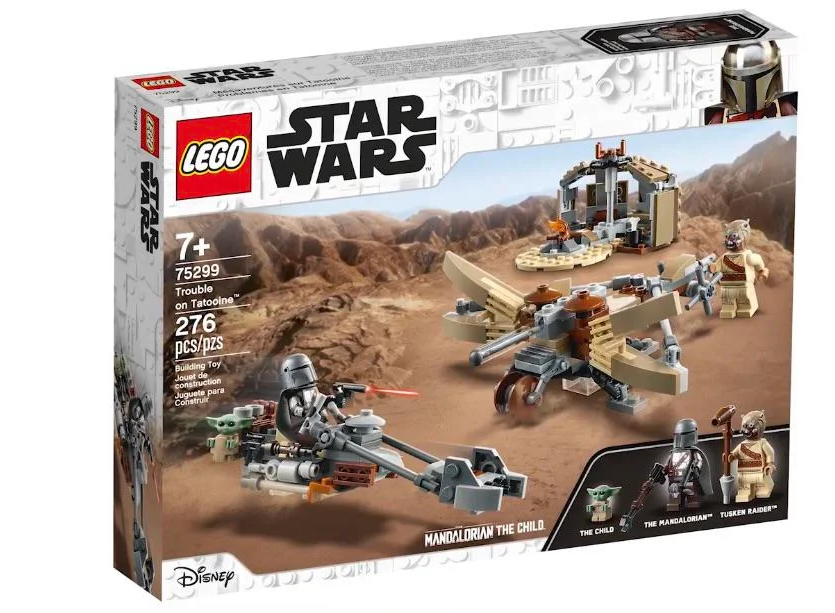
3 pointsYes, my original post was an affiliate link <my mistake>, but I edited it within a minute and its the standard link now. I was rushing too fast to get it on the board for everyone.3 pointsNot sure if posted elsewhere, but this Four Seasons moc made me chuckle...3 points3 pointsAn odd occurrence...a few days ago Walmart had Creeper Mines on sale for $63. I placed two orders of two each. They arrived today in huge boxes from Shop at Home, and both boxes had a DOTS bracelet free giveaway promotion in them. Is Walmart drop shipping from Shop at Home now?3 points2 pointsOfficial reveal from the Star Wars youtube channel 75299 Trouble on Tatooine 276 Pieces $29.99. Mando has arm printing.

 2 points2 points2 points2 pointsThat would be a game changer. Get your popcorn ready.2 points2 pointsDeals are starting to pop up. Canadian Tire 15-20% off Mastermind 30% off hidden side and lego movie 2 The Bay BOGO 50% off https://www.walmart.ca/en/toys/lego/N-11+12+36+110+1019588+100000412 pointsOne piece of advice...if this is something that you're worried about, talk to a lawyer who actually litigates tax cases. You seem to be working from a very textbook view of the law, which is fine as long as you don't have to step into court or an administrative proceeding to actually defend the conclusions that you reach. Once you cross that threshold, things can often play out very differently than the way they should based on what the textbooks say. Practical considerations often play a much larger role in driving the outcome of disputes than they should or than you would think they would based on textbook learning.2 points2 pointsCMF boxes are not sealed anymore. The only way that you can ensure a "sealed" CMF box is that is if it is still in the brown box. If you received it this way, then it is brand new, never touched.2 points2 pointsMore importantly... can't believe I missed out on $63 Creeper Mines. I have been trying to keep an eye out for a discount on these, guess I need to keep two eyes out. UPDATE: Checked immediately after posting this and got a couple at $63, thanks!2 pointsI love me some 2nd chance offers...as a buyer. I would feel bad for not paying attention for something I wanted or regretted how low my last bid was....couple days later I get that wonderful email offering it to me at that low price (now it feels like a real special deal). The psychology of this stuff is amazing...and unfortunately ownz me.2 points1 pointHeck, with TRU, @Bold-Arrow received an empty sealed envelope with only the packing slip.1 point1 point1 pointGotcha. The new Lego playbook when they need a sales boost. Pull some sets off next years avail. list. Grease the rumor mills and retirement lists. Make sets avail in dribs and drabs to ensure instant sellouts each time. Milk it till resellers are fully stocked. "change mind" and extend deadline for another year. Rinse. Repeat. Diners anyone?1 point1 pointI think the corvette was spot on...it's supposed to look like a corvette that rear ended the Mack Anthem right?1 point1 pointIf I were TLG, I would leak that story also. It's great for revenue.1 point1 pointhttps://www.brickfanatics.com/the-entertainer-founder-warns-of-christmas-lego-supply-shortage/1 point
1 point1 pointNaw... lego would have cancelled the entire order and asked you to re-order the other items. (check your cancel email from lego)1 point1 pointWish I threw something else in the cart just in case the keychain could ship before cancellation.1 point1 pointCheckout as a guest. I use the same card and address each time, I just order 3 under another name each time it restocks. My kids all have an order of 3, and the dogs just got an order now. They never cancel them. I posted the cheat code in the first reply when it came back from the dead.1 point1 point1 pointIt's been a roller coaster day. Canceled already including the keychain. Oh well, it was a fun for the 5 minutes it lasted.1 point1 pointEven if you are in these states they still may not deliver to you womp wompppppp.1 point1 pointThanks for clarifying. Yes, your math makes perfect sense. The problem is, for me, the app isn’t applying the 10% Coupon even though I “clipped” it already. I’m also not seen anywhere that says I’m getting the $15 for spending $100 (and I added a Knight Bus to bring my sales price over $100). I’m a Meijer noob. But, I will keep churning though! (Pun intended)1 point1 pointI always figured that capital gains are taxed at a favorable rate because they tend to be owned and held by the wealthy who have the power to lobby for favorable tax treatment. I'm sure there is some theoretical justification too, but I tend to take a more pragmatic and cynical view of the world. Intent is actually not the key. If you refer back to the three part test that you cite above, the first part is not an intent-based inquiry, but asks whether the taxpayer is involved in a trade or business. You can say that you did not intend to be engaged in a trade or business until you're blue in the face, but if you're doing something that looks like a business, the objective presentation of that activity will easily outweigh the self-serving assertion that you intended to be doing something other than operating a business (which will simply come across as an intent to avoid tax liability through clever argument). This first question in that test ties directly to the subsection of the statutory definition of capital asset that excludes inventory (i.e., assets held for sale in the course of a trade or business) from being a capital asset. Thus, in the first instance, the IRS or Tax Court is going to ask whether you are selling Lego in the course of operating a trade or business. If the answer is yes, that is pretty much going to resolve the question because if the IRS or court finds that you are engaged in a business selling Lego, it will be pretty hard to argue that you did not intend to sell the Lego in question in connection with that business. If you can convince them that you're not engaged in a trade or business, the asset couldn't be inventory. Also, you assert that Lego is a collectible as if it were a proven fact (i.e., "case closed"). However, what you overlook is the fact that Lego does not fall within one of the recognized categories of collectibles under the tax code and would only be considered a collectible if deemed so by the IRS under the authority granted by the tax code to categorize assets as collectibles in addition to those specifically listed in the code. The evidence that you are relying on to prove that Lego is a collectible would certainly provide a basis for the IRS to reach that conclusion, but things don't always work out in the real world the way you think they will. In reality, I would wager that your average IRS auditor is going to start from the position that what we're doing here is a toy business in which Lego is an item of inventory and that it will be a very tall hill to climb to convince him or her that it is a collectible simply because Lego appreciates over time and you did not buy it with the intent to resell in a short time frame. In my experience (none with the IRS though), government auditors tend to start from the position that you're trying to screw the government in one way or another and aren't particularly charitable or inclined to accept arguments like the ones you'd be making here. That the safest course of action. I hold the vast majority of my inventory for 12 months or longer and buy it because I think it will appreciate, but I don't think there is a snowball's chance in hell that I could convince the IRS that I'm doing anything other than running a business.1 point1 point
That would be me. I feel it looks better than counteroffering slightly higher. I also write a note saying "Thank you for your offer. Please accept my counteroffer of $0.01 less than your offer to ensure immediate payment." I think the immediate payment on acceptance of a counteroffer has been debunked here in the past, but every counteroffer of a penny less that I've sent that's been accepted was followed by a payment notification.1 point1 point1 point
2 points2 points2 points2 pointsThat would be a game changer. Get your popcorn ready.2 points2 pointsDeals are starting to pop up. Canadian Tire 15-20% off Mastermind 30% off hidden side and lego movie 2 The Bay BOGO 50% off https://www.walmart.ca/en/toys/lego/N-11+12+36+110+1019588+100000412 pointsOne piece of advice...if this is something that you're worried about, talk to a lawyer who actually litigates tax cases. You seem to be working from a very textbook view of the law, which is fine as long as you don't have to step into court or an administrative proceeding to actually defend the conclusions that you reach. Once you cross that threshold, things can often play out very differently than the way they should based on what the textbooks say. Practical considerations often play a much larger role in driving the outcome of disputes than they should or than you would think they would based on textbook learning.2 points2 pointsCMF boxes are not sealed anymore. The only way that you can ensure a "sealed" CMF box is that is if it is still in the brown box. If you received it this way, then it is brand new, never touched.2 points2 pointsMore importantly... can't believe I missed out on $63 Creeper Mines. I have been trying to keep an eye out for a discount on these, guess I need to keep two eyes out. UPDATE: Checked immediately after posting this and got a couple at $63, thanks!2 pointsI love me some 2nd chance offers...as a buyer. I would feel bad for not paying attention for something I wanted or regretted how low my last bid was....couple days later I get that wonderful email offering it to me at that low price (now it feels like a real special deal). The psychology of this stuff is amazing...and unfortunately ownz me.2 points1 pointHeck, with TRU, @Bold-Arrow received an empty sealed envelope with only the packing slip.1 point1 point1 pointGotcha. The new Lego playbook when they need a sales boost. Pull some sets off next years avail. list. Grease the rumor mills and retirement lists. Make sets avail in dribs and drabs to ensure instant sellouts each time. Milk it till resellers are fully stocked. "change mind" and extend deadline for another year. Rinse. Repeat. Diners anyone?1 point1 pointI think the corvette was spot on...it's supposed to look like a corvette that rear ended the Mack Anthem right?1 point1 pointIf I were TLG, I would leak that story also. It's great for revenue.1 point1 pointhttps://www.brickfanatics.com/the-entertainer-founder-warns-of-christmas-lego-supply-shortage/1 point
1 point1 pointNaw... lego would have cancelled the entire order and asked you to re-order the other items. (check your cancel email from lego)1 point1 pointWish I threw something else in the cart just in case the keychain could ship before cancellation.1 point1 pointCheckout as a guest. I use the same card and address each time, I just order 3 under another name each time it restocks. My kids all have an order of 3, and the dogs just got an order now. They never cancel them. I posted the cheat code in the first reply when it came back from the dead.1 point1 point1 pointIt's been a roller coaster day. Canceled already including the keychain. Oh well, it was a fun for the 5 minutes it lasted.1 point1 pointEven if you are in these states they still may not deliver to you womp wompppppp.1 point1 pointThanks for clarifying. Yes, your math makes perfect sense. The problem is, for me, the app isn’t applying the 10% Coupon even though I “clipped” it already. I’m also not seen anywhere that says I’m getting the $15 for spending $100 (and I added a Knight Bus to bring my sales price over $100). I’m a Meijer noob. But, I will keep churning though! (Pun intended)1 point1 pointI always figured that capital gains are taxed at a favorable rate because they tend to be owned and held by the wealthy who have the power to lobby for favorable tax treatment. I'm sure there is some theoretical justification too, but I tend to take a more pragmatic and cynical view of the world. Intent is actually not the key. If you refer back to the three part test that you cite above, the first part is not an intent-based inquiry, but asks whether the taxpayer is involved in a trade or business. You can say that you did not intend to be engaged in a trade or business until you're blue in the face, but if you're doing something that looks like a business, the objective presentation of that activity will easily outweigh the self-serving assertion that you intended to be doing something other than operating a business (which will simply come across as an intent to avoid tax liability through clever argument). This first question in that test ties directly to the subsection of the statutory definition of capital asset that excludes inventory (i.e., assets held for sale in the course of a trade or business) from being a capital asset. Thus, in the first instance, the IRS or Tax Court is going to ask whether you are selling Lego in the course of operating a trade or business. If the answer is yes, that is pretty much going to resolve the question because if the IRS or court finds that you are engaged in a business selling Lego, it will be pretty hard to argue that you did not intend to sell the Lego in question in connection with that business. If you can convince them that you're not engaged in a trade or business, the asset couldn't be inventory. Also, you assert that Lego is a collectible as if it were a proven fact (i.e., "case closed"). However, what you overlook is the fact that Lego does not fall within one of the recognized categories of collectibles under the tax code and would only be considered a collectible if deemed so by the IRS under the authority granted by the tax code to categorize assets as collectibles in addition to those specifically listed in the code. The evidence that you are relying on to prove that Lego is a collectible would certainly provide a basis for the IRS to reach that conclusion, but things don't always work out in the real world the way you think they will. In reality, I would wager that your average IRS auditor is going to start from the position that what we're doing here is a toy business in which Lego is an item of inventory and that it will be a very tall hill to climb to convince him or her that it is a collectible simply because Lego appreciates over time and you did not buy it with the intent to resell in a short time frame. In my experience (none with the IRS though), government auditors tend to start from the position that you're trying to screw the government in one way or another and aren't particularly charitable or inclined to accept arguments like the ones you'd be making here. That the safest course of action. I hold the vast majority of my inventory for 12 months or longer and buy it because I think it will appreciate, but I don't think there is a snowball's chance in hell that I could convince the IRS that I'm doing anything other than running a business.1 point1 point
That would be me. I feel it looks better than counteroffering slightly higher. I also write a note saying "Thank you for your offer. Please accept my counteroffer of $0.01 less than your offer to ensure immediate payment." I think the immediate payment on acceptance of a counteroffer has been debunked here in the past, but every counteroffer of a penny less that I've sent that's been accepted was followed by a payment notification.1 point1 point1 point

.thumb.jpg.5fa7ede54a890fd26316bce2da27afba.jpg)


.thumb.jpg.2388d65c77b4486ba81fd9fb9fdd1a00.jpg)


