

Leaderboard
-
.JPG.a1ea016d9ee75660906a18541e1b8ae2.JPG)
gregpj
Moderators17Points6,933Posts -
Bold-Arrow
Moderators9Points18,296Posts -
jaisonline
Moderators9Points10,856Posts -
TheOrcKing
Moderators8Points26,598Posts
.JPG.a1ea016d9ee75660906a18541e1b8ae2.JPG)


Popular Content
Showing content with the highest reputation on 05/04/2015 in all areas
-
2 pointsA video that is bound to become another Star Wars LEGO AFOL favorite. The destruction of a 10221 - Super Star Destroyer in slow motion.2 points
-
2 pointsI would argue that if this bad boy has really retired then that will be the biggest news in a long time! Yeah, the original advert mentioned that it would only be available for a limited time so that fits. It has now been scratched from all the promo material but as you say can be found by searching. Guess we have to wait and see what happens once the promo period has finished. If the stats don´t lie then they shifted around 900 units in 3 days - pretty good figures for a set that has been out for so long and is so expensive.2 points
-
Original post updated with new table capturing all submitted or corrected numbers to date.2 points
-
Big no-no. eBay insta-ban. Personally, I'd report it. This behavior hurts nearly everyone here. Yeah, he made a mistake. There are consequences to one's actions. Believe me, he's done this before. If he gets away with it time and again, he'll just continue. I'd report it, and let eBay handle it from here.2 points
-
This is price manipulation . Report them and they should be shut down or something to that effect2 points
-
Sell and buy a nice used one. Buy a couple modulars with the difference.2 points
-
2 pointsSo perhaps a used one with missing parts that has been dropped on the floor by a toddler will be worth more as it is more authentic!2 points
-
2 pointsthis might solve the issue. I just found this pic that someone put together on sifi-meshes.com2 points
-
2 pointsGot a bit lucky. Was checking the price on 9492 @ Amazon and Quidsi had 3 @ $54.99 ea. score !!2 points
-
2 points
-
Thought I'd start a thread for Irish BP'ers to discuss deals, and general investment chat. Welcome! (I've just called it the Ireland thread as the letter ****** seems to be coming up as ***** for some reason. Northern Irish members are welcome too of course.)1 point
-
Man...the characters go downhill pretty quickly. If you didn't draft top 5 you're pretty much screwed. And leave it to Tampa Bay to use the first pick on a guy who was killed by the second...smh.1 point
-
With all the upgrades and Spring cleaning I understand that the pricing guide may have taken a back seat, but I was wondering if there was an ETA on a price update? I've looked through the most recent forum posts within Site Information and Updates but didn't see anything. Perhaps this sort of update is in another section? Thanks, keep up the great work. Love me some BP!1 point
-
1 point
-
1 pointgone in LEGO Shop at Home germany the force is finally strong and the rebels made it ??1 point
-
Only sold a few at that price on Friday/Saturday these were lots of 10 for $99 2 buyers both in Asia 70/501 point
-
Used 10197 Fire Brigade, $300. Moving along in the giant lot I picked up from theplasticmanor. Tough sledding when you're sorting through 250 lbs, though.1 point
-
1 pointOh wow you're right, it's not just the exclusives either. Maybe they want a fail-safe so they don't have to dish out hundreds of items at %80 off by mistake haha.1 point
-
Agreed on this. I've placed a few orders from TRU the past month. Might want to consider leaving 21110. My February alert from Target was cancellled. My alert last week from TRU was also cancelled. (Which they didn't bother to tell me, but they did kindly add in the shipping charge since the balance of my order no longer qualified. But I digress...) There are still at least periodic notifications of availability. What about addingin 10244-1: Fairground Mixer or 21108-1: Ecto-1? Availability of either is not an issue at present, but it would be handy as the anticipated EOL approaches for the last minute rush. I don't feel strongly about adding them, just something to consider.1 point
-
..and now we know who is playing K. Ren (prob worse kept secret)
 1 point
 -
There are a few pictures in this article that I hadn't seen before. http://www.vanityfair.com/hollywood/2015/05/star-wars-the-force-awakens-vanity-fair-cover#71 point
-
I hear what you are saying, but I'm with Kshine. I don't need further issues haunting me because someone didn't like that I stood up to him. I have multiple emails back and forth stating I didn't like what he did, so I'm not worried at all about being swept up. He must have apologized 5 more times and said he didn't realize it came off like that. Sorry but I believe him. Like I said, this isn't a new user, he has perfect feedback. Maybe he's done it before, but there's something to be said for just quickly killing a person's feedback without at least opportunity to correct actions. People make mistakes. You wouldn't want someone killing your perfect feedback over an error of judgement that you did. It's almost too easy for someone to leave neg feedback or report and it sticks until you appeal. Just don't need that headache in the future. I've done nothing wrong and hopefully he learned from it. I moved on, I sold all my lots within hours anyway and did really well on them. Success in my book. But everyone's opinion were valid on here and I respect them so thank you. Oh and I also did call ebay today and spoke about it, and they said it would be anonymous reporting, but clearly the person would know it was me, so it's not all that anonymous. I blocked him as a bidder from now on, so I did do something for myself. Not worried.1 point
-
If he is mentally unstable, and counted on this as a source of income, and he believes that you caused his account to be suspended - have you really protected yourself? The correct thing to do would have been to report it without responding to the user. But since there has already been active communication - the user might look at it as if you listened to his explanation, judged him, and then decided that he needed to be punished.1 point
-
1 point
-
1 pointYou do still have to pay income tax on your profits. The reason that you get charged sales tax from your state, but not another, boils down to a legal principle called personal jurisdiction. By living in your state, you establish a sufficient "nexus" between you and that state for the state government to have personal jurisdiction over you and your commercial activities. That nexus and that personal jurisdiction gives the state the ability to impose tax obligations on you consistent with the due process clauses in the US Constitution. When you ship an item to another state, that is an act that is not deemed to have enough jurisdictional gravity to establish a nexus between you and that other state for jurisdictional purposes. As a result, you couldn't be sued in that state and, more importantly for present purposes, you can't be taxed by that state. Now, if you opened a store in that state and began operating your business there as well, that would establish the nexus needed for that state to exercise jurisdiction and impose the legal obligation to collect and remit sales tax on you. If you only have a physical location in one state and rarely ship items to that state, it would probably be worth it to go tax exempt. That's what I did and I've saved a fortune. It's even better if you live in a state that will refund the sales tax that you pay on a non-exempt transaction because you don't have to go through the hassle of having the retailer enter your exemption information. I don't live in one of those states and am not sure how many there are out there.1 point
-
1 pointLEGO offers a free polybag, a poster and some discount, 10%. All of these are freebies. The 10% discount is more than the much clamored 2xVIP everybody is always waiting for. I don't see any problem with this promotion. Regarding the disappearance of DS, it still can be seen using 'search'. It is not sold out or anything. They just made it non-orderable. If it comes back tomorrow then my theory of LEGO only willing to sell limited quantities at a discount will be verified. If not, then let the forum explode.1 point
-
1 pointYou might not consider Slave 1 iconic, but it most certainly is a space ship. Add to that the newly released Tie Fighter spaceship and where there was only 2 UCS ships for a long time (SSD and R5) we now have three. Going back to two isn't really that much of a stretch is it?1 point
-
You could also offer a trade to some one here for a used one plus cash to you. Avoid fees, and make someone else very happy, to.1 point
-
I wouldn't report it (since in this case, the seller would know you were the reason) - Trust me, there are some truly scary crazy people out there. As far as the block - you can go to the bottom of most any page, go to Site Map, then under Sell Seller Activities you will see the block bidder/buyer list.1 point
-
I personally don't tolerate price manipulation ... But that's just me . He probably tried to initimidate u and when it didn't work, he is trying to save face .1 point
-
1 pointI bought a death star from smyths.ie for €339. I couldn't help myself, i have been forcing myself to not buy one for weeks.1 point
-
1 pointSold out in europe after one day - insert Futurama "take my money" meme.1 point
-
1 pointWas able to get two Slave I's at Toys R Us, 75060, with the bogo 40%.1 point
-
1 pointDear tall guy with the Iraq war veteran cap and beard..........I see you here at TRU trying to be all discreet smooshing CMF bags trying to get the one you want.1 point
-
 1 pointDude I did the exact same thing. I'm gonna try and MOC it. I picked up 2x Bike Shop & Café 1x Toy & Grocery Shop1 point
 -
Official street date for "Star Wars: The Force Awakens" merchandise is midnight September 4, 2015. http://www.rebelscum.com/story/front/Official_Street_Date_For_Star_Wars_The_Force_Awakens_Merchandise_Is_September_4_2015_164078.asp1 point
-
Lol. Someone ^^ clearly has not watched the trailer. It is very much in the new movie1 point
-
1 pointThere are many anomalies associated with minifigure listings on eBay, so it is simpler to not have price information for them. If averaging a few listings is too difficult for you, you can also go on the BrickLink database and search up Medusa. They aren't 100% consistent with eBay, but generally are within about 15% of each other, based on personal experience.1 point
-
1 pointHit up an estate sale today. Got a used fire brigade, hogwarts express, winter village cottage, winter toy shop, maersk eee about 500+ minifigures (ranging from series to harry potter to superheroes) and about 15+ base plates (ranging from 15x15 to 10x10 road) for $540 total.1 point
-
I'm in Dublin, so there's not a lot of small toy shops, it's Smyths and not much else. I think next time I am down the country I'll be popping into every random shop which sells Lego. I got some great deals in Debenhams physical store, discounts weren't online. Just got lucky, popped in one day, not thinking I'd have much luck and there was 50% off some big sets.1 point
-
1 pointJust for you @legowalker those are the sets I got that they screwed up on, got 10 of each, all free shipping from TRU ebay store. Discounts were: 10 x Bulldozer 60074 for $5.97 Reg = $49.99 = 88% off 10 x Excavator and Truck 60075 for $5.87 Reg = $59.99 = 90% off 10 x Demolition Site 60076 for $31.97 Reg = $109.99 = 70% off 10 x Dune Buggy Trailer 60082 for $7.97 Reg = $24.99 = 68% off 10 x 4x4 With Power Boat 60085 for $11.17 Reg = $39.99 = 72% off 10 x Lego Medium Brick Box 10696 for $19.97 Reg = $34.99 = 43% off Overall it was a good day to buy lego. also got 12 getaway gliders in the mail today from Walmart @ $10 a piece1 point
-
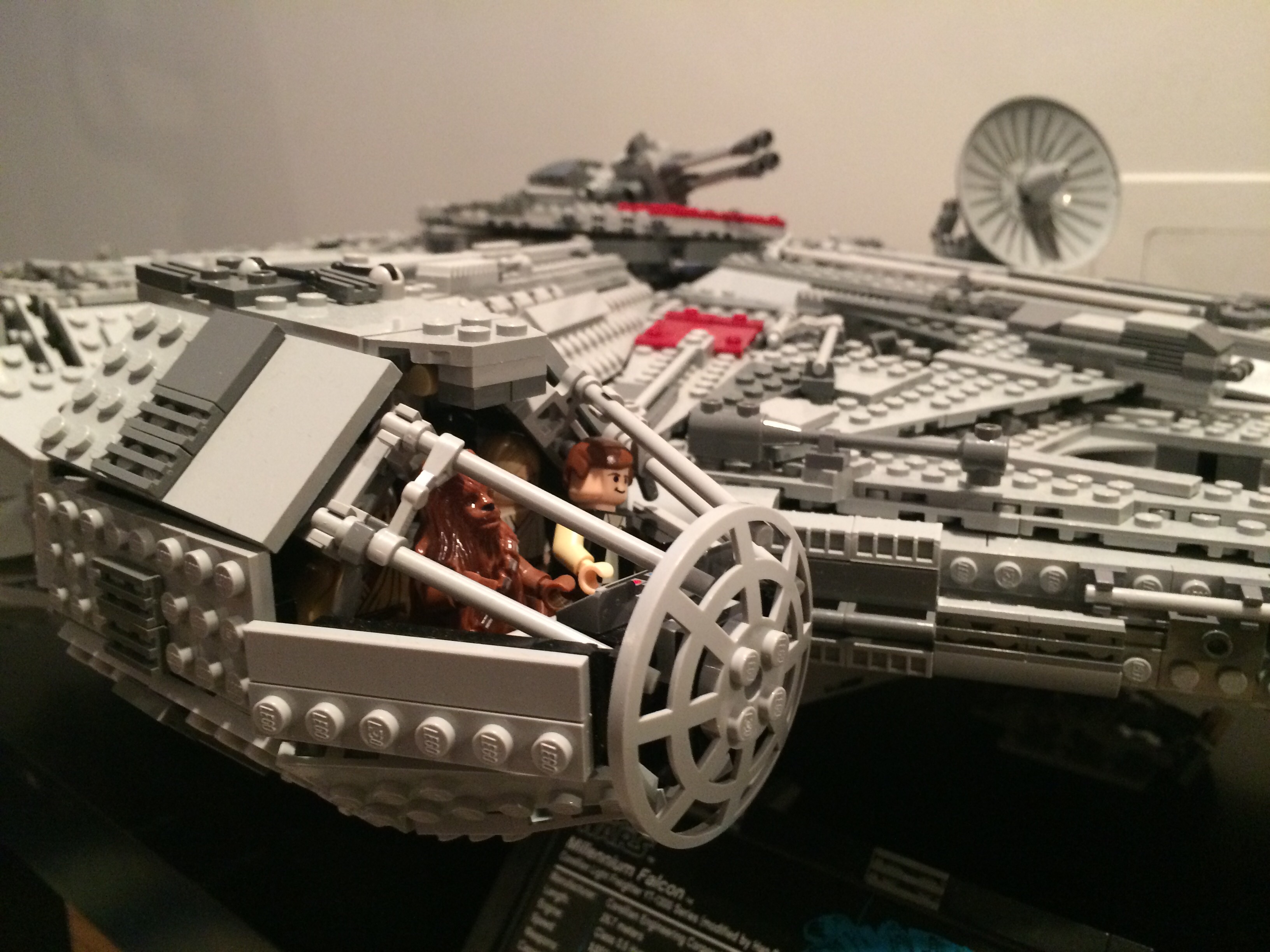
I have this set and I think it's easily a top three Star Wars set of all time. It has a presence when displayed. It's HUGE! There are definitely issues with the nose sagging after time so be careful if you are buying a used set. This can be easily remedied though with some modifications/extra bracing added to the inner frame. I did this with mine and all it took was some common pieces. Mine has been on display for three years now with no sagging issues. I will try to post pics later with my mods to the inner frame. As for the magnets, they're ok, but they could've provided bigger/stronger magnets. I have no issues moving my ISD around when needed. Ironically, someone just posted theirs for sale on CL in my area and the nose is sagging a lot. Here's a pic from the ad. It looks pretty awful but like I said, you can easily prevent this from happening. Oh, and another thing, this guy with the sales ad doesn't have the ISD sitting properly on the display stands/legs. It's not supposed to sit that low.
 1 point
 -
1 point1 point1 pointI know Trek will appreciate this. USS Hood, NCC 42296, Excelsior Class (variant)1 point1 point1 point1 point1 point1 point
Questions to think about: Are the factories where the bricks are molded the same as where the pieces are bagged and the boxes are packed? Is there only one factory where boxes are packed? Are the warehouses in the same location as the factories? Depending on how these things are distributed, very few people may have a complete picture of the state of a given set. Town Hall contains some unique (or semi-unique) parts. Say you are the mold-worker who made a batch of 61287pb001/61287pb002 four years ago. Do you have any idea how many of those went into copies of 4191, how many have gone into copies of 10224, and how many are projected to be needed for 70810? Do you know how many are still sitting in warehouse shelves? Do you know if another worker in another factory made a batch? Say you are the worker who packed a shipment of 10224 a year ago. Do you have any idea what the current inventory situation is world wide? Would you know if another shift (or another factory) produced a shipment in the past few months? Just because any individual worker can think "Hmmm, I haven't seen X in awhile" doesn't mean conclusively that X is going away immediately. Not unless that worker also knows the worldwide inventory situation. Maybe X hasn't been produced because it is a dog of a seller that is setting on warehouses gathering dust? Another factor (not saying it applies here, but just think about it) is that molds wear out or break. Part 61287 is used in only 3 current productions sets: 10235, 10224, and 70810. If the mold for that part was out of commission, but a finite supply of parts that was estimated to cover lifetime demand for 70810 was available, it would be a rational business decision to analyze the cost of a new mold, expected profit for continuing 10235 and 10224, and decide to discontinue those two sets and hold all remaining parts for 70810. Just saying that very few people in the company probably have a world-view of the factors involved before a product is stopped.1 point


