Jump to content
View in the app

A better way to browse. Learn more.

BRICKPICKER

A full-screen app on your home screen with push notifications, badges and more.

To install this app on iOS and iPadOS
  1. Tap the Share icon in Safari
  2. Scroll the menu and tap Add to Home Screen.
  3. Tap Add in the top-right corner.
To install this app on Android
  1. Tap the 3-dot menu (⋮) in the top-right corner of the browser.
  2. Tap Add to Home screen or Install app.
  3. Confirm by tapping Install.

Brickpicker Blog

Brickpicker blog articles on LEGO investing, news, reviews, evaluations, discounts and more...
So, by my reckoning (and let’s face it, who else would know?) I’ve officially been an AFOL for around 8 or 9 months now (with increasing intensity of course, as these things go). I think I’d measure it from the point at which I entered Brighton’s Lego Store and made my own Steampunk-inspired minifigures (one of which has now gone to a new home as a present to my colleague).
In these last few months it has become increasingly known to those around me that I am indeed an adult fan of Lego. This news has been met with many a reaction, but none entirely negative. And now the dividends are rolling in:
· Birthday present from colleagues: eVoucher for online Lego store which is going towards the purchase of a set I’ve wanted for ages (I think even before I emerged from my dark ages): The VW T1 Campervan. Alongside my love of Lego I have a love of VWs and it only makes sense for me to wait until September to order this as then I’ll get a free mini Lego Campervan too!
· Birthday presents from family: Lego (along with Lego cards, cakes, marshmallow lollies, chocolate brownies, brick-shaped erasers... and The Settlers of Catan (but that’s another obsession))
· Donations. I know a lot of people. I know many people whose children, like me, have grown up. People who have Lego stashed away somewhere. My first donated set came this week. A Lego Mindstorms Inventor System 2.0 from way back when Mindstorms were new. Now, as it happens the batteries have been leaking acid into the robot unit for a good few years now and it looks like it’s ruined (unless anyone can help me here?) but the fact that I got free Lego still stands (the rest of the set is still usable – and possibly there are re-sellable parts i.e. sensors etc?
I’ve also begun to affect those around me... or maybe that should be infect? My auntie text me yesterday to say they were in the Lego shop in Manchester and that they were thinking of me and that my teenage cousins were building minifigures! I’ve got a friend who has become an avid CMF collector, having only been a casual collector before we found we shared an interest. My teenage brother now builds Lego regularly (his latest a Glastonbury Pyramid Stage complete with band).
I’ve discovered that it definitely pays to be open and honest about your Lego obsession – don’t be ashamed!
The Volkswagen Type 1, or more commonly the Volkswagen Beetle, was one of the offspring of Adolf Hitler’s plan for a car that was cheap to manufacture. The car was manufactured for 62 years (1941-2003), and approximately 21.5 million were made worldwide, a world record.^
The word “Volkswagen” derives from the German phrase “people’s car”. It was designed under the requirements that it carry 5 people and be able to travel 22 mpg, a stunning number, at the time. Eventually, the car was further developed to drive more efficiently as well as have higher speeds.^
Despite the changes within the frame of the Beetle, the initial shape stayed the same throughout the decades of production. See below for comparisons:
1949 Volkswagen Beetle
1972 Volkswagen Beetle
2003 Volkswagen Beetle (Last model produced)
5 years after the final Volkswagen Beetle was produced in 2008, The LEGO Company released a model of the iconic vehicle, featuring 1,626 pieces, and retailing for $119.99 USD.
The Volkswagen Beetle LEGO model uses primarily bricks with studs rather than curved smooth pieces that could have otherwise been used to recreate the smooth flowing surface and shape of the Volkswagen. Instead, studs are used, which gives the build a more chunky shape, which I think could have been done differently, as it can be difficult to make the iconic curves of the Beetle with bricks.
This particular LEGO Volkswagen Beetle was based off the 1960 Beetle. After all, the license plate does read WOB-VW 1960. WOB an abbreviation for “Wolfsburg, the ‘home town’ of Volkswagen”*.
Now, let’s compare the LEGO Volkswagen Beetle to the real 1960 Volkswagen Beetle!!
1960 Volkswagen Beetle Cutaway Picture
LEGO Volkswagen Beetle Open Picture
1960 Volkswagen Beetle Picture
LEGO Volkswagen Beetle Picture
I personally think that LEGO didn’t do a great job with this particular set because they could have used sloped pieces, and pieces with curves in order to better recreate the actual Beetle. The LEGO version seems overall much more stout than the actual, and has too much texture to it. The interior of the car, on the other hand, was done well, especially the chairs and dashboard.
LEGO did manage to include the iconic headlights of the Volkswagen Beetle, but since the LEGO version is so wide, the headlights almost seem out of place. LEGO also could have added chrome “umbrella” pieces as hubcaps instead of the duller silver-gray color that was chosen. The rear-view mirrors of the car were done well, and very creative, which is a nice bonus. Overall, this set visually earns itself 7/10.
^http://en.wikipedia.org/wiki/Volkswagen_Beetle
*http://www.eurobricks.com/forum/index.php?showtopic=14180&#entry242123
The Volkswagen Beetle has been on a very respectable increase over the past year, and with nearly a 40% increase from $336 last June. Now, let’s look at a few tables that I put together for the Volkswagen Beetle, and the sales in the last 90 days…      


Based on these numbers, and the average total sale price of sets in the last 90 days, we can guess that the Volkswagen Beetle is worth about $572.20. Now this number does include international sales, which is different from BrickPicker data, so the number you see is an approximate value.
This means that the Volkswagen Beetle has increased in value approximately 16% over the last 2 months (June-July), or an average of 8% per month, which is a very constant growth, as it grew 7.21% in May 2013, and does show potential as a set to grab for investment, even 5 years after retirement!
Though the Volkswagen Beetle was not the strongest build, the investment potential and value of the set is high, and definitely a strong contestant in the investment game!!
I hope you enjoyed this article!
 
Over the last few weeks I've been looking into understanding how the time you decide to purchase a set for investment factors into your real investment returns. After one of my earlier blogs on how discount amounts affect your returns I began to examine how in some circumstances buying at a higher price but later in a sets retail shelf life may be beneficial.
It’s all about the Time Value of Money and the Opportunity Cost of purchasing an item when your investment capital may be better utilised in another asset. Typically sets last 18-24 months on retail shelves before retiring. If you buy a set right after it is released there is a longer time you have to hold before any potential price growth is realised.
So is it worth buying something early on if you see it at a discount, or are you better holding off to by later on at perhaps even full retail just before EOL?
Well the answer is a “fence sitting” it depends. The level of the discount offered, length of time to EOL, expected growth rate, and the length of time you are likely to hold the set all factor into the answer.
Lets take a look at a recently retired set that we have good information for and try and use that as a bit of a case study:
10212 Imperial Shuttle UCS
This well known recently retired set was released for retail sale in Sep-2010 for a retail price of $259.99. It stayed in the majority of retail outlets up until the end of Dec-2012. That’s a retail shelf life of 27 months. Over that time we can get a good picture of any retail discounts available using the camelcamelcamel.com data that is captured from Amazon.com prices and is available here on Brickpicker via the set’s individual information page.
The pricing graph above shows all the discounts available at Amazon.com over the retail life of the set. There could well have been other discounts available at other retailers, but this is the best data we have available and often retailers match discounts with each other so for the purposes of this exercise it should provide us with a good set of data to see what impacts buying at different points will have.
The largest discount was in Dec-2011 where a 30% off deal was available for a very short time, maybe a day or only a matter of hours. Earlier discounts of 10% can be seen back in Feb-2011 with the latest very good discount to around $217 of 16.5% in June-2012. After that there was only the $259.99 retail price available right up until EOL, no clearance sales here!
The current market price for the set is $354.69 based on Brickpicker data to the end of May-2013. We can use this as the benchmark to see what purchasing the set at different periods gives us as a return on that investment to date.
To compare purchase points we can use the CMGR – Compound Monthly Growth Rate that shows us the month on month increase in price. If you bought the set on day 1 at release then you would have seen a growth rate of 0.98% per month for the 32 months right through to the May-2013 price. If you waited for a bit and pulled the trigger on that first 10% sale in Feb-2011 then you have a growth rate of 1.55% per month over 27 months. If you were lucky enough to catch the big 30% sale and get one for $181.99 in Dec-2011 then you’d have enjoyed a nice 4.00% growth per month for 17 months. However if you waited until the June-2012 sale and got one for 16.5% discount at $217 then 4.57% growth per month over 11 months would be your result. Even more surprising is if you waited until the very last month and got one at full $259.99 retail in Dec-2012 then you’d currently have a monthly growth rate of 6.41% over 5 months.
Very interesting results and we can graph the monthly growth rates at each purchase point using the line graph below.
The set has grown 36.42% above retail after retirement in 5 months. This means almost all of the growth is “squashed” into those later months. Therefore the later purchase points show higher percentage monthly returns as they enjoy most of the growth in their short time span. If your intentions were to wait for initial high growth after EOL and sell now then obviously waiting later looks to have proven most beneficial. However, the longer you intend to hold the set the difference between the monthly growth rates start to even up.
For example if your plan is to hold the set for another 2 years lets see what the results after that time are. You need to make an estimate of the expected growth over those 2 years. The following table shows the monthly growth rates for each of the 3 interesting purchase points given a few different annual growth rated for the next 2 years.

You can see that as the growth rate gets higher the later purchase points have a better monthly increase. The 30% mark is about where they break even. I feel that the 25% level is realistic and slightly on the side of conservatism. After those 2 years of 25% growth per year the set should be worth $554.20. Buying the set back in Dec-11 at it’s biggest discount looks to have the slight advantage there.
The other thing you can do to compare two different purchase points is to look at the growth rates between just those two points and see how impressive that might be. Lets take the difference between Dec-11 and Jun-12. Buying for $181.99 in Dec-11 saves $35 compared to buying for $217 in Jun-12. That savings represents a 19.24% return in those 6 months, or 2.98% CMGR for comparison. The question we need to answers is could you have invested your capital into something else in that time period that would give you more than 3% growth per month?
There would have been a few sets that could have bettered that during those 6 months. For example Taj Mahal was growing an average of 8% per month during that time. Still, 3% per month is very impressive and you should be pretty pleased with it, suggesting that the Dec-11 low point was a very good purchase point.
Likewise, comparing to the opportunity of purchasing at the end of retail in Dec-12 the $78% savings back in Dec-11 represents a 12 month growth of 42.86% or 3.02% CMGR. That is also very good and you won’t find too many set options giving that sort of performance. There will be a few for sure, but picking them would have been hard at the time.
Conclusions
It’s far harder to optimise your purchase decision at the time you are presented with a discount opportunity. You don’t have a crystal ball so are unlikely to be able to know whether a discount will be available in the future. It’s also hard to predict EOL times, you can estimate, or make an educated guess based on the cumulative shared wisdom of members here on Brickpicker, but often it’s not an exact science. It’s far easier to try and look at the optimal purchase point looking backwards with the full benefit of hindsight and complete information.
I’m not sure this article will have helped you a great deal, but I feel like I’ve at least got my thoughts down on paper. I think this is a topic I’d like to return to in the future as I feel I haven’t quite captured a way to determine when the best point to buy was. It’s going to require a bit more research. At the very least we’ve been able to see that buying time does have a big impact on percentage returns on investment in the shorter term. And that the opportunity cost of buying early is the potential profits that capital could have been used to generate on a different set.
Back in the year of 1999, Lego introduced the world to their latest and incredibly epic license acquisition to date of Star Wars. In the first year alone, they released a mix of thirteen sets based around the original trilogy and beginning of the prequel trilogy. To further the themes’ collectability by the following year, they issued four of the short lived Minifigure Collection (or Minifig Pack) sets each containing three characters plus special stands and introduced the most highly detailed designs to date with the Ultimate Collector Series. Besides being considerably expensive, UCS sets featured the largest number of parts over many.
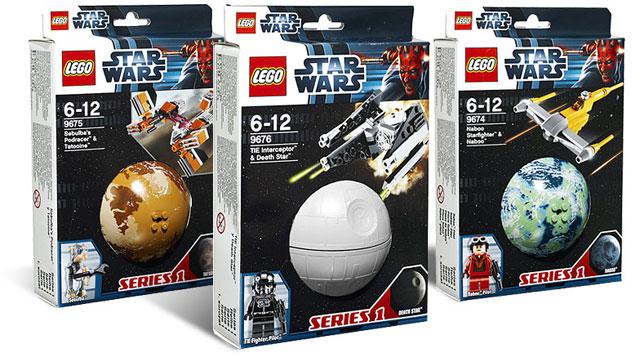
Jumping ahead thirteen years to 2012, Lego decides on raising the collectible ante for their most popular theme by launching the Planets line. Taking inspiration from the Collectible Minifigures and simple mini-builds within polybags, with a container tossed in for good measure, we end up with a one-of-a-kind and profoundly well blended collectable rolled into one neat little package. Each year (thus far) yields the release of two three-set series’ featuring various builds, characters, and planetoids which make great decorations. With a standard price point affordable by most and different facets appealing to anyone one way or another, they were an immediate success and continue to be.
Below you shall find informative tables and charts for every separate Planet from both Series 1 and 2 released just last year listing a compilation of various values for comparison. Beneath those is my general opinion taking into consideration the current values of worth, highs and lows from sales, and contributing features of design. The sold listings data are from the last five months for the two main staples of resale, eBay and BrickLink. Prior to this article, I have already written and submitted complete set reviews for each and intend on mainly focusing towards investment purposes instead of simply repeating myself. I also took the liberty of adding links under each chart to BrickPicker’s and BrickLink’s price guides. Now let’s get started.
Series 1
9674 - Naboo Starfighter/Naboo
BrickPicker Price Guide/BrickLink Price Guide
The smallest of all the Planets in both piece count and design had a steady value of worth since the beginning of last year as it was released alongside its Series 1 brethren and already reached sales of more than $30 brand new through eBay. Unfortunately, the currently going value has been wounded since a few months ago by numerous discounts found among various retailers such as Target selling many remaining leftovers from 50% to nearly 75% off. Despite varying difference in opinion surrounding the prequel trilogy, a number of people seem to like the sleek N-1 Starfighter from Naboo. While I honestly did not think this one would perform so remarkably well and fast, I also should not find it surprising for this to fall so far after being on top for so long. With that being said, I can see this making a comeback in due time. As the phrase goes, “It happened before, it can happen again”.
9675 - Sebulba’s Podracer/Tatooine
BrickPicker Price Guide/BrickLink Price Guide
Besides being the cheapest way to get a hold of the latest version of Sebulba, this has the honor of containing the largest piece count and flimsiest design of any Planet released so far. Before now, I was not quite sure where to place this one truthfully. It has had an oddball rollercoaster ride in value with a couple of high peaks and mostly mid to low valleys and still is scarcely worth more than retail at the moment. There is potential here as I am now seeing this slowly gain momentum thankfully; however, trying to capture that bolt of lightning will take a little patience and boils down to good timing. This continues to be what I would consider a mid to long-term investment assuming it does go anywhere.
 
9676 - TIE Interceptor/Death Star
BrickPicker Price Guide/BrickLink Price Guide
Finally, a personal favorite (and many others it would seem) spacecraft and Planet of Series 1! In spite of the insanely high number of listings, this has performed slightly better than Sebulba’s Podracer, had a more uniformed ride altogether and reached some decent heights. It could possibly do better if the number of people trying to sell at the same time wasn’t so high, but even then its track record shows a consistently somewhat reliable level of value and point towards a potential long-term investment despite a current dip. It’s the iconic Death Star (DS-1 Orbital Battle Station specifically) we all know and loved watching get blown up (twice no less) or firing up its laser, and both the TIE Interceptor and pilot (though not as rare as he used to be) are awesome! While listing one at this point in time will yield minimal profit, this particular Planet is just too good to not appreciate well even though that may take a while (and I do mean a while) to gradually do so.
It will be tricky gauging future values for Series 2, thanks to all of those recent discounts and the fact that some can still be found at local retailers across the country, but here goes nothing.
Series 2
9677 - X-Wing Starfighter/Yavin 4
BrickPicker Price Guide/BrickLink Price Guide
Here we start off the next series with a bang featuring the ever classic, T-65 X-Wing Starfighter! One can go on about everything done right with this set. The design at this scale absolutely cannot get any better period, and who doesn’t want another Rebel pilot? If there were any possible negatives to be found, it would be the fact this exact build was released a couple years prior in a polybag available from various Target and Five Below retailers. Aside from that, I see little to no problems for this one appreciating well if only for the simple fact of how iconic both the starfighter and pilot are. In a similarly odd way, this could almost as easily end up going down the same path as the Naboo Starfighter from the first Series.
9678 - Twin-Pod Cloud Car/Bespin
BrickPicker Price Guide/BrickLink Price Guide
A favorite secondary character and vehicle from the original trilogy of mine, now in their correct colors! Despite the small size, it is a greatly accurate representation of the Storm IV Twin-Pod Cloud Car and the completely exclusive minifigure features a nicely balanced mix between Lobot from the film and a Lego character. While I am surprised in a way with its currently low value at the same time I am not. Majority of reviews and opinions from across the web have been positive up to the point of even stating this is the best Planet. In any case, this took those countless discounts the hardest as its value on eBay has gone down to almost half retail yet the number of units sold keeps rising. Amusingly enough, this has performed better overall on BrickLink. Although this will definitely be another to add upon the list of long-term investments, I have faith in the uniqueness eventually pulling it through and even outshine the Twin-Pod Cloud Car set from 2002.
9679 - AT-ST Walker/Endor
BrickPicker Price Guide/BrickLink Price Guide
This is by far the best mini-build of the AT-ST ever and includes a one-of-a-kind version of its Imperial Pilot. Sales for this particular set have performed a little more than the X-Wing altogether, and both are selling better than the Cloud Car at the moment from either eBay or BrickLink. Opinions have been favorable and although I have found a rather similar design in a previous polybag from 2011, I can imagine this one doing very well with some ease in the long run.
On a side note, the Planet itself is technically the forest moon of Endor and not to be confused with the cyan gas planet it orbits around that the Ewoks named Tana, which will be featured in the upcoming B-Wing Starfighter/Planet Endor from Series 4.
Although I can’t say how things will fare with Series 3 and 4 at this point (leaving me room for a future evaluation), I can say however those appear to be yet another nice collection of winners! My picks for quick gainers are the Republic Attack Cruiser/Coruscant from Series 3 and Tantive IV/Alderaan from Series 4. Nothing wrong about the rest of them; all will be good performers in due time. In my opinion, Series 4 offers the best selection of spaceships and Planets altogether.
In conclusion, I have found scant few negatives in my evaluation for the 1st and 2nd series of the Stars Wars Planets line. Surprisingly enough, the Naboo Starfighter had performed exceedingly well right out the gate than every other one and could once again later on. While I can’t say I’m surprised with Sebulba’s progress, I must admit the alien has done better than I would have thought initially. The Death Star has managed to keep a steady value (though close to retail) regardless of the absolutely ludicrous amount of listings. If given the chance to grow, it should produce some nice returns. I find it amusing how the AT-ST is performing nicer than even the symbolic X-Wing and at the same time disappointed with the current standing of Bespin’s Cloud Car though I have a feeling it will perk up eventually.
After much research across the net by reading and skimming through numerous reviews and opinions, emotions towards the Planet sets have been very reassuring from a number of age groups. Seldom have I found anything negative or the opposite.
Despite all of these good points, the real question that matters remains.
Are they worth investing?
To which I can reply with great certainty.
Yes.
Their broad appeal, included features, and affordable price point offers something for everyone. First off, they are based on the most popular theme of Star Wars. Second, the included mini-builds are display ready designs able to fit in any size location and easy enough for a child to put together and play in a matter of moments, and don’t forget the exclusively printed plague that comes within every set. Third, each one features a minifigure with unique printing and/or army building qualities and practically everybody loves collecting them. Fourth, there is nothing else on the shelves quite like the Planets themselves. These truly are one of kind conversation pieces molded purely for decoration or a make shift storage container if need be.
While I wouldn’t go too off the handle by saying they will gain ridiculously large amounts in value, I will say each Planet could go as high as three times retail at some point in time. A select few may possibly go even higher than that much like how the Naboo Starfighter/Naboo once had strangely enough.
Since the entire line is still relatively in its stage of infancy, now would be the best time to invest in the starting Series’ if you have not done so already before things get too far down the road and we are looking forward to the release of Series 9 and 10 in 2016 or Series 17 and 18 in 2020 (assuming the line manages to continue for that long of course). The returns may not be the same from a typically larger set but if you factor in the inevitable discounts on an item which was already low cost to begin with, collective gains earned could stack up quite nicely.
If you did manage to stay awake long enough to reach the end of my article, I thank you.
Oh, and “May the force be with you”.
"ED"itor's Note: This informative and well written article was a collaboration of Quacs and Fcbarcelona101...
In 2006, a television show debuted in the US called Man vs. Wild. Originally a British show called Born Survivor, Man vs. Wild was a reality TV series hosted by the noted outdoorsman and stuntman Bear Grylls that chronicled his efforts to thrive in remote locations by demonstrating and using various survival skills. Throughout each episode, Grylls used every piece of information and natural resource the local landscape offered him, and provided the audience with some audacious survival techniques. Needless to say, it made for some compelling television.
Gryll’s locales provided him incredible opportunities to showcase his atypical survival techniques, and every landscape he visited was full of tools to survive. In our "reality game" of Lego investing, new Brickpicker members are faced with a similar challenge. Tools to learn and conquer Lego investing (or more colloquially, Brickpicking) abound, yet they too can be hidden in plain sight. Members' unfamiliarity with Lego investing may obscure the powerful tools that are readily available, or their inexperience may contribute to a lack of awareness of these tools. With this article, we intend to provide both new and veteran Brickpickers with a road map to our favorite site. So, strap on your waterskin and get ready to make your way through Brickpicker and all of its functions. With a little bit of guidance, its vast information can provide all of us with immense opportunity.
The first rule of Brickpicking is to make money, and in order to make money in Lego investing, you must learn how to build a portfolio. Portfolio construction is the vehicle that Lego investors use to make money. Broadly, portfolio construction includes the following steps:
Building Your Portfolio Tracking Your Portfolio Refining Your Portfolio Selling Your Portfolio While this sounds simple, learning to master this cycle will make you money in the Brickpicking game. Naturally, Brickpicker has evolved to include several modules that provide information to help conquer each of these steps. The site also includes a few additional modules that provide a break from the work of Lego investing. To unlock Brickpicker’s potential, let’s go step by step to discover the tools at our disposal to become a dominant Brickpicker.
Build your portfolio
So, you have made the decision to begin your journey as a LEGO investor. The most important question you will ask yourself is, "where do I start?". Thankfully, Brickpicker has several different features that can make that always difficult first step a little easier, but before we review them there are a few points that any investor should keep in mind:
As with any investment, diversification is key. When investing in LEGO, a good way to diversify your portfolio includes purchasing sets from multiple themes and different sizes/price points. Don't discount the small sets due to their small returns - a good mix of well selected smaller sets can reduce the overall risk of your investment. Consider all the costs of LEGO investing. Take into account all of the hidden costs associated with Brickpicking such as wear and tear on your vehicle, insurance and storage. These will be important when determining the actual ROI of your portfolio. Craft your investment strategy before hand. It is extremely important that investors establish a clear set of rules to govern your LEGO investment selections. It is very easy to buy every set that sees a discount, but this is not the most efficient way to achieve good returns in the long run. Do your research. This goes along with choosing an investment strategy. It is extremely iportfolio.mportant that investors analyze prospective investments as much as possible before actually putting hard earned money into them. You would not invest in a company you have never heard about just because it is 10% cheaper than yesterday; Lego sets are no different. Invest within your means. Don't exceed your budget just because some other investors are purchasing several copies of a set and telling you how well they will perform. Follow your strategy and don't get caught up in the hype. These points mentioned above are not the only ones you should pay attention to while starting investing in LEGO sets, but they are the most basic ones everyone should consider before jumping into Lego investing. With these in mind, let's take a look at the most important features Brickpicker offers its members when starting a LEGO portfolio.
Sales and Discounts
One of the oft-repeated mantras you will see in the forum is, "Never to pay retail for your LEGO sets". This is pretty basic advice and while an investor must consider several variables when deciding whether to purchase a set at MSRP, getting a set at a discount is your best bet to maximize future investment returns. A nice article that goes a little more into detail about the effect of discounts on your ROI can be read at Grolim's Blog.
The premise is pretty straightforward: by getting a set at a discounted price you will stand a better chance at making money even if the set ends up being an investment loser. It is pretty rare when a LEGO goes for a lot more under retail even when its investment performance is below average, so getting a discounted set will make a huge difference when it comes time to sell. Because of this, Brickpicker's Sales & Discounts module gives investors a lot of good information about currently discounted sets in the market. Once you click on the Module, several different features will drop down. Let's evaluate each one a little closer:
Amazon / Walmart / Target Discounts: These three individual modules consist of information related to the current discounts offered by each retailer. In some instances, especially with Amazon, you will be able to select the country you are interested in checking, and the list will include valuable information like the current price of the set, the current percentage discount, the MSRP, and the date and time of the last update. Please note the page will also warn you if the list price from the retailer is higher than LEGO's MSRP, a handy tool that could keep you from purchasing a set you believe has a great discount, but in actuality, doesn't.
The discount page also presents you with a Buy it Now button that will take you to the retailer's website and give the site some credit at the time of purchase. That is a free and good way to help Brickpicker!
Amazon Price Grid: This page is very similar to the discounts section we examined above, yet it does provide a more convenient place to compare Amazon discounts across different regions and a tool to sort the results in several ways. For example, if you are interested in checking only those discounts related to sets in the Architecture theme, clicking on the Quick Link will bring you to a page that shows you only those sets.
Furthermore, you can choose the lowest level of discount you want to be shown with the sorting tool in the upper right corner. If you only want to check the sets with a discount equal or greater than 20%, you can select that option and the page will show you a complete list of sets that meet that criteria. This can be very useful if you have a particular discount level that usually makes you "pull the trigger' with some LEGO sets.
Amazon Best Sellers and Top Selling Sets: These two individual modules are similar, but include information based on two different retail outlets: Amazon and eBay.
The Amazon Best Sellers page will give you the Top 100 best selling LEGO sets and products on the online retailer's site along with the current discount of each listed set, if applicable. This particular list is updated fairly frequently and you may notice that a set that used to be in position 80 in the morning might not be there by the time the night comes around. Those movements are just regular fluctuations of Amazon's sales, and most of the time the list is pretty consistent with whatever is popular at the moment.
As with the Amazon Discounts page, you will be able to select different regions to see what is popular in different locales. This is very useful not for those that do not live in the US, and for US sellers trying to determine unpopular domestic products that may flipped based on their popularity abroad.
This module also has a Top Selling Sets tab that is basically the same as the previous list, yet based on data taken from eBay. Unlike the Amazon page, this one is updated once a month with the same data that feeds the Brickpicker Price Guide (more on that later) and includes some other interesting data for you to make the best decision portfolio selections possible. For example, you will notice the page lets you know where a particular set placed on the Best Seller list during the previous 5 months. This information is critical to determining prevailing trends in the LEGO market.
As an example, say you are considering purchasing a somewhat expensive LEGO set for investment purposes and check the list to see what has been selling on eBay. If you check the list now, you will notice that the 10227 UCS B-Wing is currently in the top position. If the information from the previous months were not present, an investor may think that the ship is a great and popular choice. Yet, a quick look at previous month data would show the set placed in the high hundreds over the preceding months. A savvy investor would easily deduce there was an anomaly in the market that boosted the popularity of the set. In this instance, it was the controversial May the 4th Sale.
You can also filter the results by theme and see which set is the most popular on any given line, as well as its overall place in the Top Selling list.
Top Retired Sets: The last feature of the Sales & Discounts module is the one with the highest potential to be incorrectly overlooked. Even if most investors follow a strategy of investing in current sets, there is significant upside in finding retired sets that are still experiencing periods of high growth or what Grolim called a "Second Wind". Quite often, we see long retired sets growing rapidly in value after a period of somewhat stable pricing. Some sets never slow down and continue to grow rapidly for years (think 10179 and Taj Mahal). For those interested in diversifying their strategies and portfolio finding these sets can be a very rewarding decision.
One of the main advantages of using this strategy is that already retired sets grow from the moment you decide to purchase them if you pick the right sets - there's no wait ing for a future EOL date. For this strategy, the Top Retired Sets feature is very useful. This page shows you the top performing retired sets (released 2008 or before) over the past 6 months, and gives you their ROI. Additionally, it presents you with some eBay listings that are priced within a 20% range of the current market value. Looking for well performing retired sets is easy with using this list and the BrickIndex, a module we will discuss later.
Some other cool statistics shown on this page include the traditional set information, like PPP and MSRP, as well as some investment numbers used a lot in this site such as CAGR and monthly price movements.
These are the features of the Sales & Discounts module in a nutshell. As you can see, there are several features that will help you build your portfolio, and will prove invaluable once you get more experience and have a more polished investment strategy.
Tools and Data
Even though discounts are a very important part of the portfolio building process, they are certainly not the only thing to consider. The Tools & Data module presents the LEGO investor with several other features that will allow the decision making process to be based on data analysis rather than personal intuition or conventional wisdom. While it is very important to pay attention to the impressions of the community, a well-informed decision will always be supported with hard, quantifiable data. Let's look at a module that allows this: The Tools & Data Module. Compare Sets: Financiers compare prospective investment opportunities and historical performance of past investments routinely. When it comes to LEGO, comparing sets is equally important and will help the investor in several different ways:
Evaluate the similarities and difference among a number of individual sets when it comes to metrics like PPP, MSRP, piece count, release date. This very basic information allows an investor to determine whether the value for the money of a particular set is consistent with several others. Compare the performance of already retired sets. It is this case where most of the information displayed in the pages comes into play. Input the set number or name and a list will drop down with those that match what you are looking for. Click your preferred sets and you will see a screen similar to the one below that will include each set's CAGR (Compounded Annual Growth Rate), last six months performance graphs, current market value and percentage changes relative to several different periods of time both for New and Used sets. All of this information can help an investor determine which sets have performed better than average or at least better than the sample of sets selected, as well as help in the search for retired sets experiencing high growth. Compare a prospective investment to what you think have been comparable sets that LEGO has already retired. By doing this, you will be able to make an educated guess about a set's potential investment ROI based on the similarities of the comparables. Characteristics like theme, piece count, minifigures and other factors will determine which sets you will choose to compare. The Brickpicker Compare Sets function will allow you to select up to 6 sets, and the process is very simple and fast. Just input the set number or name and a list will drop down with those that match what you are looking for, select your desired sets to compare, and you will see a screen similar to the one below.
The BrickIndex
The BrickIndex is easily one of the best features offered by the site. This chart is updated once a month in the regular data update and displays the top performing sets over the last 6 month period. Unlike the Top Retired sets list, the BrickIndex can include sets that are not necessarily retired but have showcased high growth over the past half year, as evidenced by the current presence of sets like Tower Bridge and the VW Camper Van.
This features plays a major role when trying to determine which sets are the best to select for your portfolio as they will likely be recent, and probably future, high growth sets. For example, you will see that the UCS AT-ST set is currently in the 5th position of the BrickIndex, with an increase of around 68% over the last six months. From this information an investor could make a reasonable prediction that, even if the set has been retired for a while now, there is further growth to take advantage of given the recent trends. That said, the BrickIndex is almost always comprised of already retired sets, as by default these are the ones that usually present higher growth.
Like several other features in the site, you are able to sort the results by theme to view only those sets that are part of a line you are interested in analyzing.
Bulk LEGO Data
Sealed and used sets get most of the attention in LEGO investing due to their proven investment performance, and because of their visual appeal. However, there is another branch of investing that can't be overlooked as it is also a good source of returns for many: buying and selling LEGO in bulk.
I would strongly suggest a beginner LEGO investor to look into this alternative as a way to diversify their investment portfolio because bulk lots are relatively easy to find locally through sites like Craigslist, garage and estate sales and through the more traditional eBay listing. The appeal of buying LEGO in bulk is twofold: LEGO pieces are always in demand from MOCers and LEGO enthusiasts, and bulk lots are fairly easy to market, sell and ship; and there is always the chance that a bulk lot contains rare pieces or minifigures that can earn the investor a great return in the short term.
Since bulk lots are more for quick flipping than a traditional buy and hold, it is critical that investors knows exactly how much can a lot be sold for on sites like eBay before going ahead and paying a bunch of money for 2 lbs of common pieces that may net you a loss. The Bulk Data center of Brickpicker provides investors with the tools to find out what bulk sets are selling for on eBay based on weight.
The information on this page is shown differently to what is found the set Price Guide since sellers list bulk lots with completely different titles. The most efficient way to present this data is to have the exact listing title along with the sold price, so that is how Brickpicker's Bulk Lot tool is structured. In the listing title, the weight of the lot is listed almost all the time, so by checking the list the investor will be able to make a fairly accurate estimate of the value per pound of a particular lot.
Some other interesting features in this section include selecting the minimum weight of the lots you want to see, themes included in the lot, and colors. Keep in mind that these features rely on how well the seller listed the lot and what specific keywords were used.
CAGR by theme
CAGR by theme is the last feature available from the Tools and Data module, and it can be extremely helpful to any new or veteran Lego investor. The data from this list includes the simple average of the CAGR of all of the sets included in a particular theme, giving you an average CAGR by theme that can work as both a popularity proxy and a performance measure at the same time.
For example, the top performing theme according to the CAGR by theme list is Ninjago (44.78%), something that an investor could take as evidence that the theme's popularity is rather high and that at least several sets have presented great performance upon retirement. These high measures are especially significant when one considers this average includes the CAGR of sets that are still in production, typically much lower due to currently available discounting.
As you can see, you can use this feature to find themes that have performed well in order to reduce some of your portfolio risk. That said, it is still very important to analyze the numbers more in depth by reviewing the individual sets of the theme before making a decision. The simple average provided includes the CAGR of small sets and polybags that can double or triple in value fairly easily, and they are all weighted the same as larger sets. For those of you that prefer investing in larger sets, a weighted CAGR is a nice alternative.
Track your portfolio
So, you've done your homework, selected and purchased a cadre of diverse sets based on your own investment strategy. Now, you must follow them closely and track their performance like a stock or bond trader. Fortunately for members, Brickpicker provides investors with an incredible tool to accomplish this: the Brickfolio.
Brickfolio
The Brickfolio is the place where all the information about your investment sets can be compiled and tracked. Because it's critical for every investor to know how efficiently they are investing, the Brickfolio puts the most valuable information all in one place to minimize the time it takes to research and evaluate your current portfolio.
The Brickfolio module has many interesting features, so let's evaluate the most important ones:
My Brickfolio: This section is where the bulk of the information is shown, and where you will be spending most of your time analyzing your portfolio's performance. The first thing you will probably notice are the overall numbers that relate to your investment such as total current market value, the monthly dollar and percentage change, and more generic information like the total amount of sets and total number of pieces. Futher, the market value of your Brickfolio over the past 12 months is presented in graph form to allow for easier and faster performance tracking and evaluation.
Further down the same page you will notice three different graphs. The first pie chart provides a breakdown of the value of your portfolio by theme, something that can quickly help you determine the makeup of the portfolio. For example, if half of your portfolio holdings are sets from the Friends theme, it would be rational for you to pay a closer look at the market demand for those sets, new releases and pretty much every other type of news relating to that theme to forecast any changes in value. This does not mean you should not pay attention to those themes that comprise a small part of your portfolio, but at least you get an idea of where you should be focusing most of your time.
Also, this graph will give you a pretty nice view of how diversified you are , and how closely you are following your capital allocation strategy. If your strategy includes holding 50% of your portfolio in Star Wars sets, this graph will be a great tool to assess whether there is any need to re-balance the portfolio.
The middle graph shows you how many sets you have in each theme without taking into account the current market value: think of it as counting the number of "shares" you have on a particular theme. Finally, the last graph will give you a breakdown of how well the overall themes you own have performed relative to the prior month. This is a great way to determine underperforming sets and allows you to evaluate your portfolio a little more deeper. For example, if you use this graph to find the sets you own in the Star Wars theme have cratered, you will have to determine why exactly this happened. It's possible you are either not picking the right sets OR not having a lot of currently available sets.
To the right of the graphs shown above you will find some other bits of interesting information about your current holdings as well as some options to customize your Brickfolio according to your region. There is also a button where you can click to see your entire collection of sets currently entered in your Brickfolio, the option to change your base currency, and an option to share your Brickfolio with other users. There is also some detailed information about your most valuable sets (new and used), and some minor supplemental statistics. Finally, the Brickfolio provides a breakdown of sets by Used or New including the market value by condition.
View Brickfolio Items: This option takes you to the same page as the View Collection button in the screen above. Basically, Brickpicker shows your collection by theme with the quantity of sets in each one, and some options like adding sets to the Brickfolio (even custom sets), searching a specific set in your collection (very useful if you have a large inventory), and viewing your entire portfolio to provide a more detailed display of every single set you currently own. This last one is the most interesting of all, so here's a screenshot to demonstrate its featues and look:
After clicking the View Entire Collection button, you wil be sent to a page with all of the individual sets in your Brickfolio, along with some very useful data. Most importantly, you will be able to see your purchase price, the current market value and the performance measures for each set (including ROI), and actual dollar profit. This is the best place to analyze your individual holdings and routinely track their performance (I would recommend monthly, if not more). You will also see the total price paid for all of the items in your Brickfolio and the total current market value of your holdings at the end of the table.
Add Brickfolio Item: So far, we have discussed how to track your investments in detail, yet we have not mentioned how to enter your sets in your Brickfolio. Accomplishing this is straightforward: just click on the Add Brickfolio Item link to enter a vast amount of information about your sets such as purchase price, date, place of purchase and set condition. This information will make tracking your inventory a lot easier and less time consuming. Even if this seems unnecessary at the beginning, once your inventory continues to grow you will need to add as much detail as possible. There is also a text field where you can add any other notes you may want to keep in mind when selling or just as reminders.
Data Services: This section really consists of two very important features: the "Clear your Brickfolio" and "Export your Brickfolio". The first of the two does exactly what it advertises, it clears your complete collection without the possibility to recover any of the data, so you should only do this only if you are certain you have no need for this data.
The export feature will automatically generate an Excel spreadsheet that will contain all of the information shown in the online Brickfolio. Exporting this information to Excel will allow you to manipulate data in the Brickfolio. This will allow you to perform several different tasks, including tracking inventory and recording current Brickfolio values for insurance purposes. I would recommend updating your spreadsheet at least once a week if you are very active both buying and selling, since keeping accurate and up to date records is crucial to tracking your performance.
As of the date of this article, there is currently no option to track actual sales, so you need to delete those sets you sell in order for them to be removed. To maintain a record of sold sets while eliminating its purchase information, edit the quantity and price of your sold items to "0". Future Brickfolio updates may include a feature to record your sales, yet nothing has been confirmed.
Here is a screenshot of an Excel spreadsheet generated automatically from your Brickfolio page: Promote Brickpicker:
The last feature of the Brickfolio module allows you to create a personalized signature with preselected data from your personal Brickfolio. I would wager that members have already noticed some posts with these around badges in forum posts, but in case you missed them, I included a picture a little further down. The goal of this is not only to share some of your holdings with other members, but also promote the site on other websites, forums and blogs. When creating your own signature, there is a check box that will allow you to maintain the actual value of your Brickfolio private while still showing some of the more generic information.
Refining Your Portfolio
Now that you’ve built a portfolio, and are intently track its inventory and value, effectively refining your portfolio will move your portfolio's ROI from good to great and allow you to meet or exceed your projected ROIs. What does “refining your portfolio” mean? It means constantly reviewing the selections and purchases you’ve made in the context of their value in the market. As we all know, information changes by the minute in today’s day and age, so to ensure you’re capturing the most value for your portfolio, it’s critical for BP members to be up to date on the most current market trends and information. Brickpicker provides five modules to aid in keeping you on information’s leading edge:
The Lego News module The Evaluation Corner articles The Brickvesting Blog articles Lego Set Reviews The Discussion Forum As an example of how important and quickly Lego news can affect the market, most BP members remember the 9516 Jabba’s Palace controversy in April. A news story about how JP would be discontinued hit the Lego News module, Brickpickers reacted to it in the forum, and many profited by quickly buying and selling Jabba’s Palace at a profit to speculators that were whipped into a frenzy about an erroneous EOL report. Throughout the controversy, most of the chatter in the forum thread dedicated to JP was calm and rational. Many BP members speculated that 9516 wouldn’t be retired and even if it was, directed others to current discounts on the set to ensure all members were prepared for an EOL in case it did come. When all was said, Brickpickers were more prepared than the general market to profit from this market fluctuation, and many did in spades. With that as a backdrop, let’s review each of the modules available to refine our portfolio:
The Lego News Module
Located near the bottom of the front page, The Lego News Module is a wealth of Lego-specific information from outlets across the internet. While it appears to be a typically updating news feed, it has helped me on more than one occasion stay well versed on planned Lego releases, and industry information from a number of great Lego fan sites, as well as some national outlets with Lego-related news articles. It updates quite frequently, so chances are you will not see the same stories twice. The Lego News Module is an underrated feature, and since it only takes a quick glance to get the latest Lego information, this News Feed should be added to your daily reading rotation.
Evaluation Corner
Smack dab in the middle of the Brickpicker’s home page is the first of two user blogs that provide a vast amount of information and analysis: Evaluation Corner. In Evaluation Corner, members post in-depth analyses of Lego themes that include discussion of individual sets of a particular theme and their investment potential. The Evaluation Corner grew out of the original Set Review Module, and has become a fantastic repository of investment analysis and advice of each theme. The following recent themes are represented with analysis in the Evaluation Corner area:
Star Wars (Fall Lineup)
City Airport
Winter Village
Technic
Playable UCS Equivalents
SpongeBob SquarePants
The Hobbit
Galaxy Squad
Maersk
Lord of the Rings
Architecture
The Lone Ranger
Western
Modulars
City Fire and Police
Transportation
Super Heroes
Legends of Chima
This list is only a fraction of the Evaluation Articles that have been written, and as you can see, it encompasses some of the most popular recent themes. Rest assured, the founders read each Evaluation Corner entry and respond to the author’s analysis to provide a second opinion, while members are given the opportunity to scrutinize the article in the entries below. Everyone has a chance to weigh in on the applicability of the advice, so be sure to read these response comments carefully, too. The Evaluation Corner, above all else, helps with assessing the sets with the most investment potential in a particular theme.
Brickvesting Blog Brickpicker’s Brickvesting Blog Module has provided the site with the most cutting edge and relevant Lego investing market analysis, beginner’s guides, and investing advice on the market today in one convenient location. While the topics for these articles are as varied as they are informative, they are all well written and packed full of information, advice and in some cases, contradictory opinions. If you need some information on a particular investing strategy, would like help with eBay, or wonder how to pick the right sets for your portfolio, there are many articles from veteran BP scribes with information to help both new and old Brickpickers alike. Similar to the Evaluation Corner, the Brickvesting Blog has a response comment section for every member to assess the content of the article and challenge their notions and analyses. The site content has really exploded over the last three months, and the Brickvesting Blog has greatly benefited. Be sure to read and scrutinize all applicable articles to build your own portfolio.
Set Reviews
With over 1,000 reviews on file, the Lego Set Review Module is yet another source of information and advice for a Brickpicker looking to refine their portfolio. The majority of these reviews are in a structured format to give BP members the opportunity to understand the details, value and playability of the set in addition to its potential return. The format structure really makes the Review Module a strong tool since it forces the reviewer to provide insight beyond the useless “this set is awesome” meme. Additionally, while the Review Module has its own navigation tab at the top of each screen, the set reviews are also embedded in their respective entries in the Lego Price Guide for easy access. The reviews give very specific information by set, so they go a little deeper than the Evaluation Corner articles. Use this module to learn as much as you can about the set, but beware that many of the reviews are written by fans of the set or theme, so investment potential may be slightly biased.
Discussion Forum
Easily the most dynamic module of the Brickpicker site is the Discussion Forum, the place where all Brickpickers go to discuss Lego investing, collecting, news and stuff in general. The forum is typically a collegial place, so you will find most members quite accommodating to new members.
There are some important rules about the forum to understand and follow:
Solicitation of any kind is not allowed. Don’t post advertisements or sales you are trying to unload, and don’t solicit members for deals, business ventures or partnerships on the forum. Political discussions are not allowed. The site is not a forum for members to discuss politics. Crude language is not allowed Name calling is against the forum rules Spamming is not allowed. In addition to these written rules, there are some unwritten rules that members generally follow that make the forum a great place to cyber-chillax:
Be respectful. Members of all ages, nationalities and creeds enjoy Lego, and they all have different perspectives. Sharing your thoughts and opinions respectfully makes for a better forum. Because the forum is a dynamic place, there is an entire archive of topics that have been discussed. Before posting a new thread, check the old threads for a similar topic. There’s even a function to help with this if you’ve clicked the “New Thread” button. After typing your preferred title, the site will bring up a number of similar threads that may be a good place to post your thought. Review these, and if any are close, click on that topic and a new post will be started in this thread. Brickpicker is an international website that welcomes Lego fans from everywhere around the globe, and English is a second language to many who post on the forum. Please don’t pick apart someone’s grammar mistakes - everyone makes them! To help with quick access, the Discussion Forum is organized into five main areas:
The General Board – This board has the broadest group of threads, and is the “catch-all” for most non-investing threads. The four sub-forums in the General Board are New Member Introductions and FAQs (a great resource for newbies), Site Information and Updates (a great resource for veterans to suggest and check on changes to the site), Odds & Ends, and Building Lego. The last two include many topics that are not related to Lego investing. Members Only Forum – This board is not available to non-member lurkers, so Brickpickers that share good deal, pre-release information, and every-so-often an insider nugget will post their information here. Investing and Collecting – This board has the most topics of all, and they are generally grouped by theme. If you have a question or need some insight on Technic, there’s a theme dedicated to discussing it. There’s also a sub-forum discussing the always controversial retirement (EOL) topic, but keep in mind no one REALLY knows whether something is retired until TLC confirms it! Buying and Selling – Another with many topics, the Buying and Selling board has sub forums and threads that are centered around specific Lego distribution channels, i.e. eBay, Amazon, Toys R Us, etc. Buying and selling practices and information regarding clearances specific to these retailers can be found among these threads. Local Area Lego Deals – The most recent board to be created, The Local Area Lego Deals includes topics centered around specific locations around the world. Live in Chicago and want to discuss your thoughts about the marketplace? This is the place to share. There are other neat little features of the Discussion Forum that are used frequently that make it a vibrant platform to discuss Lego:
Reputation Points – Brickpickers have the option to give a poster some credit for a particularly useful or cogent post. In the bottom right corner of each post, there is a small green arrow – clicking on this will give the poster a “reputation point”. These reputation points give newer members an idea of which posters contribute strong and relevant content. Anyone can see the reputation points of any member by clicking on that poster’s avatar. Following a thread or forum – Members have the option to check a box in the upper left hand corner that allows them to “follow” a specific thread or forum. When following a thread or forum, the website will automatically send out e-mails with new posts from the followed thread or forum. Brickpoints – The Site Founders, Ed and Jeff Mack, have instituted a promotional system where participating in the site can earn you Brickpoints that can later be redeemed for Lego sets. To the left of each post, the poster’s information is displayed including their avatar, country, post count, Brickpicker classification (Brickpicker, Brick Troller, etc.), and their Brickpoint total. The Discussion Forum is the best place to get immediate feedback and reaction to any Lego-related thoughts or questions you may have. We look forward to both your questions and answers!
Selling Your Portfolio
So, you’ve built your portfolio, tracked it, refined it and now you’re ready to start raking in the big money! Is it time to sell that 10214 Tower Bridge, or should we wait another year? How about that Jor-El polybag you got last month for free from Lego S@H? While you have the option to ask for opinions in the forum, this is your money on the line and any serious investor wants to sell for their target ROI. How can an investor make an informed decision on when and how much to sell for?
Fortunately for members, the core module of Brickpicker is the Lego Price Guide. The price guide includes individual information on over 9,000 Lego sets. Because there is so much information in each set’s price guide entry, we must separate these entries into their component parts to understand and absorb all of it. Here is the list of the parts of each set’s Lego Price Guide entry:
Pricing information by region Photo Gallery/Set information Current Offers Monthly Listings – Quantity Sold Monthly Listings – Price Sold Price and Performance Information Set Ratings and Member Reviews EBay Listings That’s a lot of information to digest, so let’s review the features included one-by-one:
Pricing Information by Region Pricing
Information by Region includes data that’s truly valuable and sets Brickpicker apart from other Lego sites. It utilizes an eBay data capture program called TerraPeak that tracks sales of all Lego sets, bulk lots and minifigures on eBay. Brickpicker utilizes this data to produce an average value for every set that sells on eBay. To produce the pricing, the last 30 sales are used to produce an average selling price by region. In the past, Brickpicker’s Lego Price Guide only tracked sales made on eBay US, but recently eBay sales from three new regions were added to the Price Guide: Great Britain, Germany and Australia. These sales are aggregated by Brickpicker into four, region-specific sales averages to give members are clear, concise average value of any Lego set among all four regions. Not only is this incredible information, it can present an enterprising Brickipicker with opportunities to sell across country lines.
As you can see in the picture above, the Pricing Information by Region table is split into various columns of information. The Market Value (New) and Market Value (Used) are estimated prices for new and used sets respectively, the Last Month (New and Last Month (Used) are the price increase or decrease for each from the previous month, the CAGR prices measures the Compounded Annual Growth rate from a set’s release year (not its retirement year), and the Price Per Brick columns divides the average new and used prices, and the retail price by the number of bricks that come in the set to give an estimated value to compare sets across time and other themes. All of this information paints a great picture of what the relative price is for an individual set.
Photo Gallery/Set Information
This module may appear diminutive, but it packs a punch. Here, you can look up the primary statistics of every set, including piece count, minifigure count, release year, retail price in all four regions, and links to this set’s page on Rebrickable.com, Bricker.com and even online instructions for the model! It even has a separate section to show how many of these sets are in your own Brickfolio, another great little feature that goes largely unnoticed. The links to Rebrickable.com and Bricker.com are also useful in their own right as they provide further specifics into the inventory and parts list for each set, as well as other set features. Finally, this module includes another underrated feature – a photo gallery that shows images of the set. While it doesn’t sound like much, having a visual image of the set or box allows the viewer to quickly check this is the set they want to review.
Current Offers
While not glamorous, this bit of information tells Brickpickers what price point online retailers have set for this model. It easily and quickly provides a snapshot of your competition’s price when determining your own price. It also provides a pass-through link to the online retailer that sends Brickpicker a small commission on that sale that helps pay for the information the Site Owners provide for free.
Monthly Listings – Quantity/Monthly Listings – Price
The two Monthly Listings sections are also powerful tools. Essentially, they are graphs that track the quantity sold and the average price sold of new sets and used sets over the last twelve months. Remember the 9516 Jabba’s Palace controversy, or the B-Wing discounting? Graphs for both of these sets show the relative spikes in sales quantity and price during their respective market disruptions, and provide an investor with a picture of how the sets sold before and after their respective fluctuations.
Pricing and Performance Information
This is another module with incredible detailed information aggregated into useful statistics. There are four tabs across the top of the table that contain different information:
Performance Over Time – This shows the set’s current appreciation/depreciation over the past month, 6 months, 1 year and 2 year time periods. It also includes how much the set has appreciated over retail, providing a de facto measure of ROI. Recent Sold Listings – This gives Brickpickers the specific sales that TerraPeak uses to calculate its average sales price for the set. This is a great table that provides individual sales quickly. The date and “New” or “Used” designation are also provided. For new members, I highly recommend scrutinizing this list, along with eBay’s and/or Bricklink’s current sold data, to determine a sales price for your listing. Averages – More data that provides statistical measures of the TerraPeak data by region. Mean, Median, Mode, Max and Min Price statistics are all included, as well as the quantity of sales that goes into determining each average price. Live Completed Listings – This section provides a link to eBay’s live completed listings for the set. This is also invaluable to determining a fair sales price for your sets. All of this data will provide a pattern of sold prices that should help to determine what your sets’ sales price should be. Keep in mind that these are not absolute, so if you want quicker sales, you can price your sets lower than market value. If you want a higher price for your sets over this rough estimate of market value, you can see the upper limits of other sales prices.
Set Ratings and Member Reviews
This module shows reviews of the set that have been completed by Brickpicker members, and the average overall score for the set. There are links to specific reviews here, as well as arrow keys that toggle between other older reviews. This information is good to gauge a “general consensus” of the quality and potential EOL value for the set. These opinions should help with timing decisions and pricing decisions for your sets’ sales.
EBay Listings
This module is nothing more than its title: a list of active eBay listings for the set. Yet, it still provides members with loads of information. First, if your set has already been listed, you can view your competition to see whether you have a good chance at a sale. Second, if your set hasn’t been listed, you can see where your actual competition has set their prices. Finally, you can see how many listings you will be competing against for a sale to determine whether this will likely sell quickly or slowly.
There are a couple limitations of the Price Guide to note. First, the prices are generally updated on the 15th of every month for the previous month’s sales, so this average value is not a real-time price. Second, eBay sales prices are only as good as the sales’ corresponding listings, so if an eBay seller lists a set as “New” but titles the listing “without Minifigures”, this listing is still captured by the Lego Price Guide data as a “New” set. This can sometimes under report the actual value of a new set. A quick review of the sold listings will net individual sold listings of the average value, and it’s usually easy to tell the average listing and an outlier that may not be an actual NISB sale.
Ultimately, all of the information in the Lego Price Guide exists to help you determine market value for a set. Once you know market value, you can determine whether your set will garner your targeted return parameters. If you believe you can meet your sales targets, it’s time to sell! Proper research and use of the Lego Price Guide will make you an informed and intelligent seller, and allow you to see your portfolio’s expected returns converted to actual returns. What you do with all that profit is up to you!
Have Fun and Share!
So far, all we have discussed has dealt with how to use Brickpicker effectively for LEGO investing, but that's not to say Brickpicker members are about all work and no play. In fact, there are several features that are designed to provide members with a break from the "stress" and "work" of deal hunting and selling LEGO sets (even though most investors don't consider this an actual job). Let's take a look at some of the most important ways you can relax a little and share things with some of the other members.
Personal Blogs
We have already talked about this great feature earlier in this article, but it is important to point out that personal blogs are not limited to investment related articles. Of course, Brickpicker caters to investors, but the personal blog section gives any member the freedom and a space to share pretty much anything LEGO related. Do you have a fun story about how you got started into LEGO or about your MOC creations? These are completely valid topics to discuss in your personal blog!
Gallery
Brickpicker members have access to a gallery feature they can use to upload images and charts for articles or reviews, or to post pictures of MOCs and personal displays. There is really no limit to what you can share with other members in pictorial form, and we can all agree that sometimes a picture tells more than you could ever describe in a forum post. You can even comment about other member's images and share your impressions!
Image Hosting
Brickpicker's image hosting module is a very useful feature that was just recently added. For those of you that have used sites like Photobucket already know what I am talking about, but for those that don't, image hosting sites allow you to upload images from your personal computer or device and store them in the cloud while providing you a link that will make your images visible and easy to share. By copying the link, you will be able to insert the picture pretty much everywhere, from posts to blogs for all to see.
Awards
When posting in the forums, there are several "actions" or milestones that will earn you one of the many awards available to members of the site. Things as simple as posting a certain amount of posts or focusing on some particular feature of the forums can net you a badge that will show under your avatar. The following are just some of the awards currently available to members, but the list may include some extra in the future.
Brickpoints and Brickpoints Store
As mentioned previoulsy, the Brickpoints system is sort of a rewards program for those members who decide to become active participants on the site. There are several ways to earn BPs, going from regular posting to submitting Evaluation Corner or Brickvesting Blog articles that get published. For a list of detailed ways to earn points please visit the following link to the Brickpoints Program.
Once you have earned your BPs, there are many ways to use them right here on the site. Think of them as some sort of e-currency that allows you to "purchase" sets at the Brickpoints Store, getting them in exchange for your regular participation. They will also be used to reduce listing costs once the Brick Classifieds platform goes live (TBD). Let me emphasize this again: BRICKPOINTS ARE FREE, so make sure you participate in the site and get rewarded in the process!
Just to give you a taste of what you can earn with your Brickpoints, I included a screenshot of the BP Store below.
As you can see, there are several different ways to enjoy the site even when you feel overwhelmed by all the investment talk. It is therapeutic to take a break and enjoy talking about LEGO with other fans from around the world, and special forums like Odds & Ends, Building LEGO and the features described below are there precisely designed to help with that. We really hope you try them all and pick those that are the most interesting and fun.
If you've lasted this far, you have officially survived Brickpicker's version of Man vs. Wild. As you can see, the size and scope of the website is enormous and tackling it can be daunting. Hopefully this guide has both provided you with the road map to navigate the site, and placed you solidly on the road to making money investing in Lego! Enjoy your time discovering and exploring the site, and don't hesitate to use this as a reference. By and large, Brickpicker exists to help its members make money, and we hope you are successful with your Lego Investing adventure.
- FCBarcelona101
- Quacs
Ed and I would like to give a special Thank You to both Quacs and Fbarcelona101 for putting together this extraordinary user guide to the Brickpicker site. It is something that is long overdue and these guys did a fantastic job. Much better than I personally could ever do. We can't thankyou enough! Bravo!!  


We have all read it before: "I got 5 Vampyre Castles at Walmart for $ 50 each!". Clearance finds is one of the most popular topics of this site, to the point that there are several different threads centered around it. Of course, it makes sense. It is to be expected that when a LEGO investing sets gathers around people from all around the world there is going to be some natural "bragging". To me, that's not bad at all, especially since most of the times members of this site are helpful enough to post where they got it as well as some other information that may help other members to get similar deals.
This abundance of what everyone sees as amazing deals has an effect that can be both positive or negative, depending on the individual investor that happens to read them. On one hand, seeing those kind of prices can move the investor to a more active deal searching strategy that can pay off big if they are diligent and insistent. On the other, there is a chance that a particular investor looking for clearance deals is spending more money and time looking for deals than it is worth it to them.
Why could these two scenarios be so different? well, there are several variables that impact an investor's ability to find good deals. The following are just some of them:
Investor's location: It is no secret that the best deals are often founds in either smaller towns or "low income" neighborhoods. Finding good deals in the larger cities is extremely difficult, both for the sheer amount of people concentrated around the stores and for the variety and, usually, abundance of middle to high income families. Investor's effort: It can't be denied that someone who tries harder is more likely to find good discounts than someone that only makes an occasional trip to the large retailers. Having said that, as we will see later this is not necessarily a good or bad thing in and on itself. Store policy: Most of the time, the decision about what items to clear from the stores is left up to each store's manager. There is not much the investor can do about this point, just get to know the local store policy and maybe get to know the employees. To me, those three are the most important factors that result in an investor being able to find or not clearance deal in their particular location.
Having laid this out, I want to get to the real point of this article: Is hunting for clearance deals really cost efficient and rewarding both short or long term?. There is no clear answer to this question, as each investor is different and has a different strategy and resources. When I was writing my Cost of LEGO investing articles, I got to see first hand the financial impact hunting for clearance deals in stores can have on the investor's bottom line, so in here I would like to isolate that topic in particular and determine who can benefit and who can't with this strategy.
For the mentioned article, I used the AAA estimated cost per mile to drive a vehicle in the US as a way to know what is the price of driving around from store to store on any given day. Adding to that, there is definitely the cost of the investor's time that could be spent doing something else, but since that is really dependent on each individual there is not really a good number I could use that applied to everyone, so just know that we are keeping that out of the equation.
AAA's estimate cost per mile driven is somewhere around $ 0.61. This cost is inclusive of gas as well as pretty much every single cost that is included while driving like insurance, repairs, etc. So. let's examine several different scenarios using only one set as our main example. Let's base our numbers on 9474 Helm's Deep and use several different investor profiles.
Scenario 1: The investor drives 15 miles to the local Target/Walmart and finds Helm's Deep on clearance for $ 80. Purchase: 2 Sets. (Taxes are ignored)

Scenario 2: The investor drives to the same store, but this time acquires 5 sets, all of the ones that are available on the shelf.

You can clearly see that, logically, the more sets the investor purchases the more the fixed cost of driving is spread out. As a result, the investor buying in larger quantities actually benefits greatly from the clearance price, while the small buyer gets a price that is not much lower than what we have seen on the set at some points.
Now, this analysis leave something out of the picture: it assumes both investors did only one trip to the retailer and found the set on clearance on their very first try. We all know this is extremely unlikely, and even if it were to happen it is very hard that this could be the case every single time the investor visits the store. Usually, investors make several trips to the stores where they find absolutely nothing worth purchasing, so let's add those costs to our analysis.
Scenario 3: The investor drove to the store two times before scoring the deal explained above, and purchased the 2 sets on his third visit.

Here you have it. If the investor drove three times back and forth between his home and the local retailer and bought the two discounted sets at $ 80, the ending cost of each set is almost $ 110. We have seen the set at around this price point several times on different online retailers. Scenario 4: Same as Scenario 3, but this time the investor bought 5 sets on the third visit.

Once again the large investor gets a better deal. Having said that, I think it is pretty evident that the potential costs are very sensitive and can add up quickly in both cases with each individual visit to the store. The moment the investor visits the store more than 4 or 5 times without finding a deal, the more costly those purchased sets will become. In a lot of cases, the actual cost of the set may very well end up being more than its MSRP. Also, keep in mind that we are ignoring the cost of the investor's time in the scenarios above.
Even if you only consider gas as your only driving cost, something that is not accurate, the cost of driving a total of three times to a store located 15 miles away from your home will add around $ 10 to the total cost of your sets (assuming 30 MPG).
What this analysis tells us is that most investors from this site will get better results by purchasing the sets online and browsing the different sites for good deals rather than spending the time and money driving around the stores. Of course, there are some investor that can benefit from hunting for clearance deals:
An investor who knows their local market extremely well and scores deals in most of his visits. Brickpicker member Lowest Form Of Wit has several times posted how he is able to visit his local stores (especially Walmart) and get at least one great set for a great price. This does not mean everyone can do it, it just happens that his area is good for LEGO hunting and he has been able to capitalize on that opportunity. High volume investors: As proven above, those investor that have the resources to invest in several copies of the same set are the ones that would benefit the most from hunting local deals. By purchasing as many sets as available at clearance price they are able to spread out the fixed costs of driving among a large amount of sets, therefore making it worth it. If you fall into any of the two categories above, you could continue with your deal hunting strategy as you see fit, always keeping in mind all the costs involved. If you are a different investor than these two types, you are better served spending your time hunting for deals online instead of hunting for that 50% deal that once you factor in the cost of the times you did not find anything can end up being equivalent to a 5% discount....or even to paying above MSRP!
In my last blog entry, I estimated and discussed the number of Lego sets, and number of sets by model, that Lego releases yearly. To summarize my estimate, TLC releases about 82 million sets, and roughly 160,000 of every model number globally.
To further the discussion, I figured I would try to estimate the number of sets, and number of sets by model, that are released by continent to get a better feel for each of these mass markets, and then try to further segment these mass markets into markets by specific countries.
To determine the percentage of sets for each continent, I looked up the GDP by continent, and used the percentage of continental GPD vs. global GDP to come up with a multiplier. Then, the quantity of sets and sets by model were multiplied by the GDP percentages to come up with a set total by continents. Without further ado, here are the results:
Data provided by the World Bank
Asia: 30.8% of global GDP / 25.2 million sets / 49,700 sets by model number
Europe: 30.5% of global GDP / 25.0 million sets / 49,200 sets by model number
North America: 27.8% of global GDP / 22.8 million sets / 44,900 sets by model number
South America: 6.0% of global GDP / 4.9 million sets / 9,700 sets by model number
Oceania: 2.5% of global GDP / 2.1 million sets / 4,000 sets by model number
Africa: 2.4% of global GDP / 2.0 million sets / 3,900 sets by model number
What do we glean from these estimates? First, while the US market is the biggest in the world, the Asian continent claims the biggest GDP, and therefore the largest percentage of sets among the continents. Europe is actually second largest, slightly behind Asia, which begs the question of whether pricing differences between European and North American markets are about how each market perceives the value of the toy rather than the competition of the market.
To get a deeper, and perhaps more useful estimate of how many sets each individual markets receive, let's further segment the continents into specific countries. I will use the % GDP of the country to the continent and multiply this percentage by the quantity calculated for each continent above. Here are the results for specific countries by continent:
countries are listed in alphabetical order by continent
Asia - 49,700
China: 38.8% of Asian GDP, 19,300 sets per model number
Japan: 28.1%, 14,000 sets
India: 8.7%, 4,300 sets
South Korea: 5.3%, 2,600 sets
Europe - 49,200 sets
Denmark: 6.4% of European GDP, 3,100 sets per model number
Germany: 16.2%, 7,970 sets
France: 12.5%, 6,150 sets Italy: 9.6%, 4,720 sets
Spain: 6.4%, 3,150 sets
UK: 11.6%, 5,710 sets
North America - 44,900 sets
Canada: 9.5% of North American GDP, 4,270 sets per model number
Mexico: 6.2%, 2,780 sets
United States: 82.2%, 36,910 sets
Oceania - 4,000 sets
Australia: 90.3% of Oceania GDP, 3,600 sets per model number
New Zealand: 8.3%, 330 sets per model number
Here's what I gleaned from these numbers.
First, the one major caveat with this model is that we know TLC doesn't distribute the sets produced to regions based on its GDP. I used GDP as a proxy for the measure of a country's economic activity and assumed TLC would distribute sets based upon this economic activity, yet this doesn't account for historical factors, purchasing patterns, regional tastes, maturity of the market, etc. As a result, I would expect the Asian figures to be overestimated since China, the second largest market according to the model, is a much newer market than many of the European and North American markets and TLC hasn't had the time to develop as the Lego market in other parts of the globe. In this same vein, I would anticipate the European markets are slightly underestimated by the model.
That said, there are some interesting observations we see from the model's output. First, this can provide a good concept of the scale of the American toy market to the rest of the world, and an idea of the competition within. When putting the set quantity into a market context, we see that the average number of Lego sets distributed by model number in the US is nearly 37,000 sets. While that seems like a lot on its surface, let's compare this quantity to the number of Walmarts, Targets, Toys R Us, Barnes & Noble stores and Lego Stores in the US:
Walmarts: 3,490
Targets: 1,725
Barnes and Noble: 777
Toys R Us: 600
Lego Stores: 35
Total major brick and mortar retail outlets selling Lego sets in the US: 6,627
This exercise neglects a whole host of regional and national chains where Brickpickers and others purchase their sets, and another major online resource, Amazon. Quickly assuming these outlets comprise another 1,000 retail outlets, we estimate the average number of lego sets by model number distributed to each retail outlet is 4.9. With 508 model numbers, that means the typical US retail outlet will receive 2,489 total Lego sets in a year, a reasonable estimate by any measure. We know that not every model is sold in every store, so this estimate has some bias.
Drilling down to from the macro market level to the micro market level can be quite illuminating, and provide Brickpickers some simple estimates to better understand the primary market. The more investors know the primary market, the better decisions they can make regarding their investment decisions.
 
I recently went to the store and could not believe some of the clearance deals they have on LEGO sets. Before this trip I purchased Jabba's Palace and spent about the exact same amount of money. However, I nearly doubled the amount of bricks for my buck compared to the single set. I will break down each purchase for you with excel graphics. NOTE: I was going to do the excel bit, but for some reason this site wont let me copy and paste pictures and it doesn't leave excel cells in the right format. See Attached if you're really interested.
Purchase 1 Set ID Set Name Price Paid Retail Pieces Price per Brick 9516 Jabba's Palace $101.72 $119.99 717 $0.142
So I made this purchase in March 2013 and I was brand new to the investing game. I saw it on sale at WalMart and Immedtialy purchased it because it was on sale and there was only 2 on the shelf so I assumed that those were the last two EVER!
Since then, I have seen many more around, but overall I am still fairly happy with this purchase. It has quite a few minifigures and my friend had the old one (4480) that we played with quite a bit in our preteen years and that one did fairly well from an investing standpoint.
On to Purchase 2; Purchase 2 Set ID Set Name Price Paid Retail Pieces Price per Brick 3816 Glove World $14.82 $19.99 169 $0.088 6865 Captain America's Avenging Cycle $9.62 $12.99 72 $0.134 6865 Captain America's Avenging Cycle $9.62 $12.99 72 $0.134 44005 Bruizer $6.87 $12.99 62 $0.11 76001 The Bat vs. Bane: Tumblr Chase $29.66 $39.99 368 $0.08 76009 Superman Black Zero Escape $6.34 $19.99 168 $0.04 76009 Superman Black Zero Escape $6.34 $19.99 168 $0.04 76009 Superman Black Zero Escape $6.34 $19.99 168 $0.04 76009 Superman Black Zero Escape $6.34 $19.99 168 $0.04 9677 X-Wing Star Fighter and Yavin 4 $7.40 $9.99 77 $0.10 Total $103.36 $188.90 1492 $0.07
Now these items were on clearance and I was floored at how low some of them were. I immediatly drove my scooter two blocks home and got the SUV to bring these back to my apartment. I will highlight a couple of the key components of this purchase comparison.
1) Money Spent Number of Bricks.
I spent nearly the same amount on both purchases. However the first purchase containted 717 pieces and 9 minifigs at $0.142 per brick.
The second prucase included 1492 pieces (more than double the first) and 26 minifigs at an overall of $0.07 (including 2 Captain America, 4 Superman, 4 Lois Lane, 4 General Zod, Sponge Bob, Sandy, Patrick (covered in chocolate ice cream), Batman, Gordon, Bane, and more).
2) Clearance Deals The highlight of the purchase was the 4 Superman Black Zero Escapes that I was able to pick up for 70% off each. You just can't pass up a 20 dollar set when you can get it for $6.34 after tax. Those were $0.04 per brick Astounding!

3) Unorganized
The store's inventory was really unorganized. I walked around a lot and I found LEGO sets in the LEGO isle, clearance LEGO sets in 3 different isles, clearance LEGO sets along the back wall, and clearance LEGO sets on the end caps. Every time I turned around there was another surprise. This disorganization was really helpful because I feel like there are probably a lot of people that would have bought one of those 4 Superman sets at 70% off if they had been in the LEGO isle. (Usually that's where people look for LEGO sets ).
4) Location
A city/town size of 20,000 is just about right for this. The population is big enough to move inventory at a decent pace, but small enough that there are probably not many LEGO investors looking for the deals I am.
I did go back two days later and they marked the prices down even further on a few items. It turned out that I missed the mark down by one day, but with a few of those sets there was only one left so oh well. I picked up one more Captain America's Avenging Cycle for 6.87 at 50% off and one more X-wing Star Fighter for 5.28 at 50% off.
I will be going back this week to see if I can get the last Captain America's Avenging Cycle for 70% off. I also passed up a firefighting set that was normally 40 dollars and was marked down to 13.98 so I'll see if that's still there. I am probably going to make this a weekly endeavor considering how close the location is to my apartment. I have decided that I will only purchase sets at 70% off unless I want multiples at which point I will purchase at 50%. And if I really want it. Like with the Sponge Bob sets, I will buy them for 30% off. I don't know about you guys, but I am never paying retail again.
FTL: Faster Than Light is a top down, real time strategy, rogue-like indie game created by developers Subset Games released for digital distribution on September 14, 2012. The general premise is you, the player, are the high ranking commander of a faster-than-light travel capable spacecraft belonging to the remnants of a once great Federation trying to transport secret tactical information to headquarters which could ensure victory over the malicious Rebels all the while avoiding destruction or capture from the aforementioned foes. Although in the beginning you have access to only the Kestrel-class cruiser, there is a total selection of nine different ships each having their respectively unique layouts, equipment, and crew; all of which is upgradeable and customizable to a degree. Warping between waypoints on a randomly generated grid of space vectors, you never know who or what you may find in an effort to reach your destination with every leap potentially being the last before possible annihilation. To form one final note before moving along, some of the gameplay and look has been considered to share similarity with the Battlestar Galactica tabletop board game.
Official Trailer – IGN

Now on CUUSOO is a submitted collaborative project between CrashSanders and GlenBecker with the approval of Faster Than Light’s original creators, Justin Ma and Matthew Davis, featuring a number of creative mini builds based on various star cruisers from said indie game.
Kestrel

Federation Cruiser “Osprey”

Engi Cruiser “Torus”

Stealth Cruiser “Nesasio”

Slug Cruiser “Man ‘O’ War”

Zoltan Cruiser “Noether”

Mantis Cruiser “Basilisk”

Rock Cruiser “Bulwark”

Coinciding with what was stated on the designers’ project page and personal blog; these are very much like the same designs found in the Star Wars: Planets sets which could be considered a niche area. Although they may not possess intricately high amounts of features, I have respect for anyone who can make something come across more detailed than it actually is in the same way pixel artists do within their artwork.

In closing, I believe this idea has some hidden potential. True, perhaps the mini builds will not impress a number of people but the decision to build at such a small scale could have been more to do with Lego’s seemingly strict stipulations against large detailed builds especially for relatively unknown properties. (You can read a more in depth article about the project designers’ decision to go micro-scale here on GlenBricker’s blog review titled “FTL: Why not make them bigger?”) Considering the Minecraft project based on an indie game itself passed review to be turned into an actual licensed Lego product and has become so popular they will be releasing two more sets based on the property, somehow I find this idea also based on an indie game having little resistance in being passed.
Since the Faster Than Light project was approved past the Summer Review deadline (June 3rd), this shall be up for assessment by Lego in September. Until then, let us keep a couple of fingers crossed for something good to come from this. Who knows? Maybe Lego will design a minifigure scale version of the Kestrel.
Thank you for reading.
In this entry of the BrickIndex Spotlight we will be focusing our attention in only the second set from the Architecture theme that has been retired so far (if you don't count the Sears Tower version as an actual retirement). Up to this point, we have really not had any significant amount of data to determine the secondary market success of sets in the Architecture line, and we have been using the only retired set, John Hancock Center, as our only guide. Thankfully, Sungnyemun can now be considered as retired even though you might still find some renegades at your local B&N stores. Let's take a look a closer look at this set.
Sungnyemun 21016 is based on a National Treasure of South Korea located in Seoul. Even though the site can be considered historic and a world landmark, it really does not hold the same international appeal that some of the other ones reproduced in the theme like the Empire State or the White House. The representation is actually quite good, and in my opinion a must have for any Architecture collector. Having said that, I believe that the less known nature of the landmark can really shed some light in just how popular the overall theme can be. In my opinion, if this particular set does well in the secondary market, it should follow that the most famous buildings represented on the theme will do at least as well (Always keeping in mind differences in size, detail, price, etc.)
The following are the graphs based on Brickpicker data about quantity of sets sold and value information:


The first graph shows eBay sales activity over the past 12 months. As you can see, the set has a pretty decent activity level that is even greater than some of the smaller and, one would think, most popular designs. It will be interesting to see if the sales trend continues in the coming months.
Second, and most relevant to us, is the values graph. This graph shows a clear upward trend starting around the month of February that seems to have stabilized a bit between April and May. This type of movement is typical for a recently retired set, but at the same time it helps confirm the investment potential of the Architecture theme as a whole. The set is currently at 80% over retail, still shy of the 180% showcased by the JHC. There are, however, some differences between these two sets that we should keep in mind while doing this analysis. First and foremost, the JHC was a smaller and cheaper set, something that usually translates in larger percentage changes by default if the set ends up being successful. Also, Sungnyemun was on the shelves for a shorter time than the JHC, about a year, something that could help explain is recent rapid growth in value.
My personal take on this set is that it has already gone through most of its rapid growth phase, leaving some room for long term growth. I would imagine that given a shorter production run the set might experience larger returns than most of the other Architecture sets, but then again it has is relatively low popularity to sort of cancel that out, in my opinion. Still, it is pretty early to determine if the set will end up being an investment powerhouse, but for now I would not invest further in the set at its current market value. I would, however, consider selling some as a relatively quick flip, or just hold for a few months to see where it goes.
Recommendation: Hold/Sell
I think there are many types of investors and many types of investing strategies that those investors use. We all look at different sets in different ways and I think that 80% of Lego sets or more have an investor somewhere that believes in them. If you have read any of my stuff, you know I am one of the more safe investors out there – I don't invest thousands and thousands of dollars so I try not to reach with any of my buys. Yes, I may not cash in on sets like the Zombies, but I am more interested in as close to guaranteed growth as possible. Because of this I wanted to really take a look at a set that I think is possibly the most safe investment out there, even at retail price: The Monster Fighter's Haunted House 10228. The Monster Fighters theme is one that was met with a little skepticism at first. I think most people thought there was definitely a market out there for Halloween themed sets, but in looking at the lineup, some of us wondered how well these would take off since there really isn't a central story behind everything. However, after the resultant popularity of the sets and the fact that The Zombies 9465 is sitting at somewhere near 1 Billion percent CAGR, that has been put to rest. There is obvious growth potential in the secondary market for this theme. When I first looked at the them, I honestly wondered about several of the sets. I had seen them all in Walmart and had thought they were kind of cool looking, but nothing really stood out. The Vampyre Castle set was somewhat tempting, but again, I didn't have that familiar theme or factor that really pulls me towards any of the sets like Star Wars and Lord of the Rings. I had heard there was another set in the theme – one that was Hard to Find. These were coming out right when I was just getting to into Legos, so I didn't understand much about Hard to Find items and how scarce they are. I happened to go to Disney World shortly thereafter and had a chance to see this set in a display case. I was amazed. I am absolutely not a Halloween fan. I don't mind the culture of it, but I hate dressing up and I am not really into giving out candy and going to parties. I think haunted houses are aright, but nothing that I see and have to go in. But this set just floored me when I saw it. The incredible detail and the fact that the set just shines when it is displayed. Your eyes are absolutely drawn to it. I went back after this and shortly later found Brickpicker. I started to research other's feelings on the Haunted House and have really studied the history of secondary investment winners. Now, looking at this set compared with everything else out there right now, I can't see a set that will come close to matching it in growth potential. Yes, the Zombies will continue to grow, but as a smaller set, it most likely has a ceiling. This set doesn't have much of one in my opinion. So, I decided to do an in depth article about the set and go as deep as we can to really look at its investment potential. A note before hand: I would love to do a picture review/build of this set, but I only have a few at this time and I have not broken any open to build. I may soon though. First off, let's look at everything the set offers according to Lego: The crooked Haunted House is home to the scariest ghosts and monsters. Tremble in fear as you open the gate, go weak at the knees as you step onto the porch and gasp in horror at the fireplace, kitchen, office, folding staircase, bedroom, potion room, music room and collection of other creepy objects. Dare you enter the Haunted House?!
Add to your LEGO® Monster Fighters Collection with the first official LEGO® Haunted House! Includes 6 minifigures: 2 glow-in-the-dark ghosts, Vampyre, Vampyre's Bride, Zombie chef and butler Features unique ‘crooked’ design featuring boarded up windows and working front gate. Haunted House opens to reveal detailed interior with 3 floors. First floor features fireplace that swings open and displays a ship in a bottle on the mantle. Cook up a ghoulish meal with the Zombie chef in the kitchen complete with old-style stove, jars and table! Write letters from the Vampyre’s haunted office! Pull the lever hidden in the chimney to release the drop down staircase and access the top floor! Top floor features gramophone, records and newspaper LEGO® elements. Customize the Haunted House with new stickers for wall hangings, spider webs and curtains! Measures 15.4” (39cm) high, 9.4” (24cm) wide and 7.5” (19cm) deep Just looking at the description and picture itself, what do we see that really screams winner about this set? Detail! It is insane! I am sure a lot of you are like me and have noticed that over the history of Lego sets, one thing that Lego does really well is find ways to improve details of a set. The easiest way to look at this is to examine the remakes inside the Star Wars themes. Most of the remakes are tremendously more detailed than their older counter-parts. This set represents the pinnacle of that detail. Just looking at the outside of the house, it is amazing. The fence is so crisp and real looking. The building looks like a model. My father was into model trains and we used to build modular buildings like this that were hard plastic. This looks like one of those. It is hard to tell from farther than a couple of feet that it is Lego. The outside of the house is smooth and the colors are perfect. The wood across all the windows and the shutters hanging off really show this set off. The wood bricks are very realistic – I recently built the Orc Forge and was really impressed with the wood bricks in it, and this set has more than 10! But Lego, in their infinite wisdom, does even more for us. The house itself has rooms – It opens up! The chef's kitchen with the pot and the snake is just tremendous. But I think it's the smaller details that set the set apart. In the kitchen, there is a bottle and a Lego jar along with a stove and a pot on that. There is also a large spider web in the corner. In another area there is a tiny record player and the set comes with another mini Lego record. In the bedroom, there is a chest along with the headboard and there are torches on the walls and a plant in the corner. The set also comes with several bottles with an assortment of items inside them including bones. Details like this just don't come in other toys.:    
On the left hand side, there is a staircase leading up form the first floor to the second. I really love the ladder, though, on the second floor that goes up through a hole in the floor to level 3. There are pictures all over the walls as well. The outside of the house is an amazing display piece while the inside is a giant play-set:

The minifigures are tremendous as well. The Lord Vampyre and Vampyre's Bride and the two Ghosts are all great, but they are found in other sets in the line so they don't add a ton of value to this set. However, there are two exclusive minfigures in the Zombie Butler and Zombie Chef. The Butler is my favorite of the two. I think he is amazing looking. He will really be the popular and expensive minifigure from this set. The Frankenstein-like head is great and the Butler getup with the vest and white shirt is perfect. The tray and the bottle and wine glass make the character as well. Without knowing the name of the figure you know it's a zombie butler!

The Zombie chef is not far behind. The gray face is really mesmerizing and the nasty green grin really sets it off. Of course he has the normal Chef attire, but it is covered in blood. This minifigure is going to be extremely popular as well.

On top of this, this set is a tremendous value at $180. $.09 PPP is exceptional on a Hard to Find set and especially one of this caliber. Most of the best PPP ratios are in sets like the Tower Bridge and Taj Mahal that have 4-5K pieces. At 2000 though, there aren't too many sets that meet this standard and are still this impressive (really R2D2 is the only obvious one that comes to mind). So why does all this make us think the set will be a good investment? If you look at the best gaining large (2000+) sets of all time, what do most of them have in common? Detail! Go back and look at the modulars that have retired like the Green Grocer 10185 and Market Street 10190. How about 10179 the Millennium Falcon? How about the 10196 Grand Carousel? What do all of these have in common? Crazy, insane detail. I think this set fits right up there with all of these. But this set has even more. Lego has really started, in the last several years, to try to make larger display sets that also have a play-set value like 10188 the Death Star and 10236 The Ewok Village. This set is really one of kind in the fact that it is a large modular and a play-set. There is really something for everyone. Unless you hate Halloween and haunted houses, how could you not like this set? For the record, my wife hates being scared and therefore hates haunted houses. She loves this set. Looking at it I can't find a bad thing about it. So, I think I have driven in how cool this set is – What can be compare it to? Well that is the hard part. It is one of a kind. But that only helps it as nothing can rival it. The only really good comparisons we have are 2 retired modulars: Both have done incredibly well. And again – these were just really display sets. This one has a play-ability aspect as well. There aren't a lot of kids that have all the modulars. This set fits right with the modulars, too. Take a look at this picture of them together with the Haunted House:
Looking at these, and the modulars in general, each new set has had about 10% less CAGR. Market Street is sitting at around 57% CAGR, and then the most recent in the Green Grocer is sitting at 34%. I for one, can not imagine that the Haunted House wont match the Green Grocer. But to be safe, we can say our expected lower limit is 30%. Looking at the two comparison sets, and what this brings to the table, I think this set could come close to hitting 50% depending on all the factors we will discuss below. It will be tough to match Market Street, but this set has an insane amount of potential. So I think most people could look at the set and say “Yes it is really cool” and “Yes other modular-like sets have done really well”. So what else really sets this set apart? What is the set's X-factor? Here we go:
Monster Fighter theme popularity – This may not be the most popular theme of all time, but Lego has nothing else like it. Every year, Lego comes out with another popular movie theme, or another Castle theme, and more Star Wars sets, but this is simply a unique theme. And because of that, getting one of these sets is not enough. You can't buy a Vampyre Castle, and just throw it in between all your Star Wars and Lord of the Rings sets. You need more Halloween sets to go with it. I really feel there will be tons of people out there that will buy a few of these sets in the theme – and have to get them all. Chances are, this theme is one and done as well! Halloween is popular – A lot of people aren't like me and really enjoy Halloween. I sold a couple of Monster's Fighters sets recently to a woman on Ebay who communicated with me a little bit after it. She asked me if I had a Haunted House or The Zombies. I apologized and said no I didn't have any for sale. She wrote back that she had never liked Legos a lot, but loved Halloween and just had to have these. She wanted to collect all of theme and bring them out every year for Halloween. My wife mentioned the same thing. A lot of people will buy Monster Fighters sets and not know this one exists. I live in a moderately Large town and I am from a very Large town. I have searched every Walmart and target in these towns and have never seen this set there. I think there will really be a good number of people that will not know this set exists until it's gone. Lack of discounts – As investors, our number one rule is “Don't pay retail”. Well, that isn't an 100% rule. Would you pay retail now for a 10179 Falcon, or any of the modulars I mentioned? This set has seen literally almost 0 discounts. This is evidenced by the fact that this set is selling for over retail on Ebay. I remember a couple of $10 discounts and the possible Amazon mistake that led to a few selling for $135. Other than that, this set has seen none. I think this is only good for the secondary market because less of them have been sold in bulk. I don't think there have been many people that have seen a discount and bought 20 Haunted Houses. Exclusive minifigures are zombies. Enough said. So with all of this, I have to give a real estimate on it's CAGR right? Earlier, I gave you my limits of worst case 30% to best case 50% CAGR. I honestly think this set will at least see 40% CAGR after 5 years, assuming it retires at the end of the year. With everything I have mentioned, I feel it will be a bit of a disappointment if it doesn't. I am planning on building it in the near future and I have no doubt my projections may improve. It will fit right in with the other modulars in terms of growth. At 40% CAGR, that would make this set worth $968.08. I think it has potential to even do better than that. The set is one of a kind and I think its growth in the next several years will be one of a kind. If you do not have one of this set or more, what are you thinking? I don't think any current set right now has anywhere near the potential this set has. I have trouble everyday buying other sets because I feel like I should put everything I have into these. I think hell will freeze over before this set doesn't do well in the secondary market. I plan to buy as many more as I can afford and I will buy them at retail if I have to. This set is worth that. If you are waiting for a deal, look at those projections again. Is a $10 or $20 discount worth risking missing out on a set with this kind of potential? Sure, 40% CAGR in the current investor and reseller-full market is a little insane. But if anything currently out there has the insane detail, the insane play-ability, the insane popularity, and the insane potential to match it – it's the Haunted House. Note: All of the information here are my own opinions and are pulled from my experiences. You may or may not have success with these methods. Thanks for reading! [ReviewAZON name="LEGO 10228 Haunted Mansion" id="1" display="inlinepost" asin="B0095ZMTE6" trackingid="brickpicker-20" country="" width="200px" float="left" imagetop="10px"] [phpbay keywords="lego 10228" siteid="1" sortorder="BestMatch" minprice="150.00" templatename="default" paging="true"]
The Millennium Falcon is one of the most iconic ships in the Star Wars movies and it is personally one of my favorite ships. Unfortunately, I cannot afford to buy the 10179 (yet...) so I was ecstatic when they produced a large play-set model to sustain my Star Wars fantasies until I can get the big one.
I have been storing this set for a while, so I was really excited to get one out and build away. And what better way to display that than to take pictures of the set and do some investment analysis? I have 5 more of these, so I hope the build and research works out well so I am inline to make money on my investment.

First up, the box. I generally have not liked the newer Star Wars boxes and, while this one is decent, I don't see anything about it that screams “Buy Me!”. It is fairly large which is enticing, but other than that it is just a picture of the set with some small pictures in the back ground. On the other hand, the Falcon doesn't really need a lot of fanfare – it brings its own.
The largest set I have built to date is 9516 Jabba's Palace which is slightly over 800 pieces. When I opened this box, this set just felt huge:

How big are these 5K piece sets??? As I was starting to sort through the bags, it really threw me off. I figured there would be 10-15 bags. I was confused very quickly to see that there were several bags that had the same number on them:
Like I said, I have never built a set this big so maybe this is normal. This meant I had to open them all at the same time and pour them into a pile ( I can't stand not having pieces available). Unfortunately, this makes it a lot harder to try and find some of the smaller pieces. After pouring out the 3 bag 1's, there are 300-400 pieces on my carpet.
First, we get to go through the minifigures though. There are no unique minifigures in this set, but I did not have a Darth Vader yet so I was really excited about him. I really liked how they did his head in gray. I guess I should have expected it, but it was surprising to see since all the minifigure heads are pretty close to the same until you attach their hair-hats.
Put on his helmet and I swore I heard the Imperial March in the background.
Chewy is up next. I really like the figure, but I have 3 or 4 of these already so it was a little boring. I feel like at some point they could do him a little differently.

Han is next. His outfit is the same from several other sets, but I really love the smirk. I think they had to of been looking at an actual picture of that Harrison Ford smirk.

Leah is next with her white garb and hair buns. Again looking at pretty much the same minifigure from other set. The Leah in the Jabba's Palace was a lot more fun.

Obi Wan is the next minifigure. He is another main character I only have one of. The hat and cape are done really well. The face gives off the old, but wise look as well:

Last, but definitely not least is Luke. He is a duel outfit minifigure. You have your normal everyday Luke:
And then your training Luke:

On to the tremendous amount of pieces sitting in front of me. The bottom part is the base of the ship and holds up pretty well. It is mostly bigger flat pieces held together by 2X4s and 2X8s. There is a slot for an escape hatch as well as spot for a walkway to get up the ship. Nothing crazy exciting in the first bag, but nothing too repetitive either.
You can see form the bottom of the ship the hatches and how the bottom is patched up. I was impressed how well the base of it stayed together.

Moving on to bag 2 and we have a lot more fun pieces. This is filling out the inside of the set with all the little toys and gadgets for the characters to use inside the Falcon. There is the control board with two seats. You also have the chess-like round table game that they were playing in the movie with seats around it. There are also several other little sets, tubes and boxes around the set to really add a lot of detail. Since this is supposed to be a play set, these are key to the set's success. Kids want to have easy ways to use their imagination. I enjoyed this bad quite a bit because of all the little unique pieces:
Here is a picture of the console:

Bag 3 is the opposite. It is very repetitive and tedious. In this section you are creating the back and mid-sides of the ship that are between the base and the dome-like top of the ship. The build is not necessarily bad, but since it is round, you create the same 2X6 block of pieces in slightly different ways until you have enough to go all around the ship. The problem with this is that they are all just a little different. With repetitive builds, I like being able to make 4 or 5 of the same thing at the same time to save page turning, etc. Unfortunately, all of these were different so they had to be done one at a time:
And now we add the booster on the back of the ship:
May not look as good as 10179, but it isn't a $300 lattice piece right? One weird little thing a ran into was a couple of pages in the book still connected together. It is pretty late at night while I am putting so I won't lie about the fact that I may have spent 5 minutes trying to figure out if there was some secret way to open up a centerfold or something.
The next bag was another accessory and touch-up bag. You added onto the side of the ship where the small cabin is on one side. It also included solidifying the middle section of the ship for all of the outside dome pieces to connect to.
It also included putting on the ship entrance walk-way on the bottom and the guns. They look pretty cool and spin around. There are also feet so that it doesn't sit directly on the ground:
Second to last bag and it's a big one. This one is a lot like bag 3 with the repetitive builds. This includes all the dome pieces separately. There are a couple of places where you could build parts a the same time so it wasn't quite as bad. I was surprised, but there is no way to actually connect these pieces together. I knew the ship itself opened, but I thought there would be a way to really close it up. It looked good, but as you can tell from the picture, it was hard to get all the pieces to fit down flush. As a display piece for me, I would have liked it just a little bit cleaner.
You can also see the satellite and the other set of turrets on the top:
The last bag is very small. It is the front wedge pieces for the ship along with the side cabin for Han. It was about the size of a normal smaller set's bag, so it was a good switch up from the huge amount of pieces all the other bags had.
The set itself is really impressive. Even though it has 4.5 times less pieces than the UCS model, it is still huge! It barely fits on my shelf that is a foot deep. I really think the detail is great. Sometimes a set being a play-set is better for display because you have a lot of extras.
I will say I noticed that some of the parts popped off pretty easily. Inside where you are really supposed to play with the set and minifigures, the set is really solid. However, if you try to fly it around (not that I did that), it is really easy to knock some of the smaller pieces off.
Still a very impressive and pleasing set and a good build. I have no doubt it will continue to be a very popular set and will be an investment winner (as we will discuss below):

It's investment time! This set should be really easy for us to make a good prediction on. There are two pieces of this set's potential that I can see as relevant: How have the UCS remake play-sets done? And How have the other Falcons done? The one thing to pay attention to is: with the other falcons, is there anything close enough to make this seem like a non-unique remake?
Quickly, by UCS play-set I mean a set that is a slight remake of an older UCS set but it is much smaller and includes more extra parts for playing along with more minifigures.
So what sets match this?
Well, I don't want to rehash too much widely available information, so I would suggest that if you haven't checked out FCBarcelona101's article on UCS Play-sets, do it now:
http://www.brickpicker.com/forum/index.php/blog/4/entry-227-star-wars-ucs-playset-edition/
I want to pull two sets from that article that I think best compare to this set. This is the 10198 Tantive 4 and the 6211 Star Destroyer:
10198: 9.59% CAGR
6211: 17.17% CAGR
None of those sets blew their original UCS set out of the water, but they were both pretty solid and seem to still be steadily growing thought hey have both been retired for several years. Looking at the two, I think the Falcon best compares to 6211 because the 10030 Star Destroyer is really expensive so people buy the smaller one and I think the same thing will happen with this set. When people have a good alternative to a $2500 set, that is a good thing for the smaller set's growth.
Now, how have the other Millennium falcons done?
7190: 663 pieces, $99 retail, 6.89% CAGR, 137% ROI
4504: 985 pieces, $99 retail, 1.63% CAGR, 15% ROI
10179: 5195 pieces, $499.99 retail, 31.81% CAGR, 422% ROI
7778: 356 pieces, $39.99 retail, 16.34% CAGR, 83% ROI
 
Besides 4504, our data looks pretty good. 7190's CAGR is only about 7%, but it has been around almost 15 years, so that it expected. 4504 does scare me though. Looking at it, it is not a lot different from this set. It has the sections that open and the little play-set area inside. It had 5 minifigures that were pretty normal characters as well.The 7965 has a little bit on it with a few extra minifigures and having a more sleek design. It is also about 300 pieces bigger. This is still fairly problematic, though, and a reason why I wouldn't go crazy on this set.
I think in the end it will experience solid gain. This set has been really popular while it has been out and should retire at the end of the year. I would guess a safe CAGR would be 12.5% after 5 years. That would put this set at $252.28 and give everyone a nice solid gain. I would definitely recommend avoiding this set at retail, but picking it up at the $105-$110 range will be very solid and should allow you to double your money at that 5 year mark (3ish years after retirement).
All in all though, the set is great and I would definitely recommend building it if you can. It is a really nice, large display piece and a good sub-in if you don't have the UCS set. Don't expect this set to put up the same numbers as the 10179, but I wouldn't bet on it to lose. Note: All of the information here are my own opinions and are pulled from my experiences. You may or may not have success with these methods. Thanks for reading!
81,711,327!
That's the estimated number of Lego sets produced in a year. Let this sink in for a minute.
Almost 82 million Lego sets are produced in a year.
How did I calculate this? It's actually fairly straightforward. Using 2012 data:
1. I found an estimate online for the number of bricks produced by TLC in a year: 19 billion
2. I divided this by the average number of bricks included per set according to Brickset's 2012 set list: 221
This yielded a "gross" number of sets produced in 2012 assuming all the bricks produced went directly into sets: 86,011,923 sets.
3. I threw in a reduction factor to account for bricks produced that didn't make it into retail sets: 5%
This yielded the current estimate for the number of Lego sets produced in 2012 of almost 82 million.
That's an incredible number of sets produced by TLC - it's not surprising they're the largest toy manufacturer in the world! Once I had this number, I divided it by the number of models with at least one brick produced in 2012: 508. This yielded an average of 160,849 sets made per model number in 2012.
Armed with this information, I thought it would be intersting to come up with a mathematical model that predicts the number of sets produced based upon the model's piece count. As you may imagine, this was a little more difficult than figuring out how many Lego sets are sold in a year. Here's the mathematical model I came up with for the line of best fit (where x = is the piece count and y = the number of sets produced by model number).
y = -295x + 226,014
So, we can use this model to estimate the number of sets produced for a given model number. For example, 79003 An Unexpected Gathering has a piece count of 652. Plugging this into the equation will give you a estimated production total for An Unexpected Gathering of
=(-295)(652)+226,014
= 33,674 units produced
While this was an interesting exercise, the model has some obvious and severe restrictions. The most notable flaw is the basic premise that Lego bases production runs based on piece count. This simply isn't accurate. Another limitation is that it breaks down for sets with high piece counts. Plugging in any set greater than 766 piece count gives you a negative production number, which is impossible. We can probably assume that the mathematical model is likely a curve with limits at the y-axis, and some minimum production run quantity above the x-axis (I would guess it's 10,000 for sake of argument).
For those that would like to play with the Excel spreadsheet I used to determine the line of best fit, I have attached it.
WithIn the context of the controversial discussion regarding the Limited Edition 4x4 Crawler, you can see that a 20,000 unit production run is actually larger than the production run predicted by the model (which, I know, is negative - see model limitations above) based upon plausible data points. According to the model, 41999 would fall into the "negative production run" area, which means it would be in a group that would likely receive a minimum production run with a quantity based upon some breakeven production cost.
The model works for what it is: an estimate of production quantities by model number based upon a production run. Hopefully, this has provided at least some scale and possible limits of an average lego production run. My biggest takeaway was the average production run per model of 160,000. After checking out the spreadsheet, let me know if you find any other insights or issues!
 
ProductionRunModel.xlsx (129.56KB) : 33
Benchmarks: LEGO Technic
This the sixth entry in a series of blogs that analyses some of the data we have available here on Brickpicker to provide some simple averages to use as benchmarks. I have done the Star Wars, Ninjago LOTR/Hobbit, City, and Super Heroes themes and this time it’s the turn of Technic!
My aim is to provide some basic stats for the theme mainly around averages for a few simple measures relating to set sizes and value for money metrics. I’m going to leave out investment return measures such as CAGR and the various ROI time periods we have available as I think they should be a different discussion and the fact that current retail sets often muddy the results when looking at theme wide averages. I’m only going to look at US based information in regards to retail price etc.
This information should prove useful in writing other blog articles or set reviews. It also should serve as a benchmark to be able to compare a set against the averages for its theme, which may or may not be useful but the option is there. Over time as I hope to complete more of these blog posts we might also be able to compare themes against each other.
Technic has proved a bit tricky to look at. There are a wide variety of set types and a lot of weird and wonderful pieces that come as a set by themselves like the Power Functions parts released in 2008. These kind of “sets” throw averages off wildly as they are expensive and have very low piece counts. So I decided to include only sets with a piece count over 10. These better represent true building sets to me. There were also plenty of sets that had a $0 or unavailable retail price, mainly the very old ones as Technic is an ‘evergreen’ theme and has been around for decades. I decided to simply exclude all these $0 retail sets as well.
Basic Information
Even after the exclusions listed above I have gathered data on 246 Technic sets from Brickpicker set pages.
For the Technic theme there isn’t an already well established consistent list of subthemes that I could find. So what I decided to do was to put the sets into natural groupings as much as I could, pulling out trucks, bikes, cranes, etc and leaving the rest in a catch all miscellaneous ‘Other’ group. I hope that proves to be useful in helping us see if there are any differences between the types of Technic sets and could be so if you want to compare a one particular vehicle type to the averages of its peers. Totals will give us the overall results for the whole theme.
A note on the groupings with set counts in brackets. “Bikes” (20) contains any kind of motorbike. “Cars” (50) contain cars of course along with any type of buggy or kart. “Cranes” (13) also include things with long telescopic arms. “Digger/Loaders” (26) contain any excavators and tractors and bulldozers. “Planes/Choppers” (17) is anything that flies. “Truck” (30) is fairly obvious. The “Other” (90) category is anything that doesn’t really fit anywhere else.
Pieces
The average piece count per set is 373 pieces. The splits for all the groupings can be seen in the graph below.

Retail Price
The 246 sets have an overall average of $43.34 for retail price. Again the splits are presented below.

You do have to take a little care in interpreting these averages as they are from such a long time span. Things like inflation not to mention wide changes in production costs (offset by efficiencies somewhat I’m sure) make prices from many years ago hard to compare to today’s environment. I can tell you though that out of the 246 sets just over half were released after the year 2000 so that’s a healthy number that keeps the averages fairly relevant still.
Price Per Piece (PPP)
Whether you like using PPP as a measure of value for money or not I have included it here as it has become quite a common metric for people to use. Personally I don’t put much stock in it and find it quite a blunt tool.
The overall average for the 246 sets is $0.150 per piece. That seems a little high compared to the conventional benchmark of $0.10 per piece. There are no license fees for this evergreen in house theme to push the budget up a bit for this Lego line. Technic sets often contain specialty pieces though so you would expect that to drive prices up a little
Price Per Gram (PPG)
PPG is in my opinion a better indicator of retail value for money. It takes into account the amount of raw ABS plastic material you get in the box and should be a closer approximation to the cost of production of the set.
Weights were not available for 37 of the sets. For the 209 sets that I did get weights for the overall average PPG is $0.070.
Minifigure Count
Well this is a section I usually put in for most themes, but it isn’t really relevant here. There are only 25 Technic sets that have a minifigure and the last of those was released back in 2001. Technic is a theme geared towards building these days and not minifigs.
Thanks for reading and I hope you find a use for some of these numbers either in your own writing or your own investment decision making.
The differences in retail prices that Lego attracts across different countries and regions is an often talked about subject. There is always a feeling that Lego, both with its own stores and online shop and with the suggested retail prices that most big Lego retailers use, doesn’t exactly play “fair” when it comes to pricing. The reasons for that are many and varied and are beyond the scope of this article. But what I would like to do is present some evidence that may help put into perspective some of the retail pricing discrepancies.
A couple of months ago Brickpicker expanded the information available to us to include data from 3 regions outside of the established US Ebay results. The UK, Australia (AUS), and Germany (EU) were all added to the information pages for each set. Along with the Ebay sales data we also have a small section showing the retail price of each set. It is comparing these prices that I would like to focus on.
For the purpose of this exercise I gathered the retail prices for 345 sets released in 2011 or later across many different themes. These 345 sets had retail prices available for each of the 4 regions. There are plenty of sets that have no retail price available in one or more regions so those were excluded. 345 sets should give us plenty of coverage to examine any differences.
To compare the prices in a meaningful way first we need to convert them to a common currency. So I took all the prices for the other three regions and converted them to US$ prices using the latest currency exchange rates as follows:

Now all the prices are converted we can compare the averages across the 345 sets:

From that picture you can see all the regions above the US in terms of pricing. “Aha, but wait!” some of you may be saying, “What about sales taxes like VAT?”. A very good question! Each region has a different form of sales tax added into the retail price. The UK and Germany have VAT (Value Added Tax) and Australia has GST (Goods and Services Tax). In the US the sales tax depends on which state you are in and is added on top of the retail price when you pay. Therefore to compare prices accurately we need to remove the sales tax component from the regional prices at the current rate:

VAT was increased to 20% in the UK in 2011 so that was another reason to limit the set data to that year and after to make things easier to analyse.
We can now look at the averages for each region with the sales taxes removed:

Things are a lot more even now. The UK is almost identical to the US and the EU price is 5.0% higher. Aus is still up there 28.9% higher than the US though. This gives us a snapshot of how current retail market prices differ at the overall average level. I then wondered if there was any differences between themes. So here is a look at the 345 sets broken down by themes and ranked based on the variance of the average of the 3 other regions compared to the US:

This table throws up some stark differences in the prices across the themes. You can see that Spongebob has the highest variance but only 4 sets, followed by the heavy hitting Super Heroes theme whose 18 sets are on average 28.1% higher than the US. 50.5% higher in Australia in fact! Interestingly we have the Technic set at the bottom, where apart from Australia the other 2 regions enjoy a decent discount below the US price. This is probably why the recent sales on some Technic sets at Amazon.uk have proved to be very popular with members here, with many importing them from the UK to the US at excellent prices even after shipping costs. City is another big theme where the variance is positive for those two regions as well.
How about the best (I guess best depends on which country you are in), or highest and lowest individual sets? Starting with the lowest:
The lowest i.e. the set with the lowest prices in other regions compared to the US goes to the 7553 City 2011 Advent Calendar which is an average 35.2% lower than the US retail price. In fact the top (bottom?) three spots are taken up by advent calendars with the 9509 SW one and the 2012 City one coming in next. The 42007 Moto-cross Bike comes in next with -20.4% difference, certainly one to look out for perhaps if another sale comes up.
The highest i.e. the set with the highest prices in other regions compared to the US is the 6873 Spider-Man's Doc Ock Ambush set with an eye-watering 58.9% average premium in the other regions compared to the US. 6867 Loki's Cosmic Cube Escape with 57.2% and 6866 Wolverine's Chopper Showdown with 57.2% as well. So if you live outside the US and are shopping for those Super Heroes sets it look like it could be a good option to import them from the US. All dependent on what sort of retailer discounts are on and shipping/customs costs of course.
Conclusion
Currency exchange rates do fluctuate and these can have quite a bearing on the differences between the regional prices. For example the AUD was trading at above $US1 for quite a while earlier this year before dropping 10% in value recently. This is probably one of the main reasons that Lego prices things differently due to what currency rates they have locked in long term through hedging mechanisms etc. Because of these changes I may look to update this info perhaps quarterly or 6 monthly.
The overall differences between the regions after sales tax removal have been less than I had envisaged. Though the swings between different themes and individual sets with them have been wider than I thought. It would seem Lego likes to price things not only on currency but what the market may bear. I’ll leave the possible reasons for another discussion or feel free to post your thoughts in the comments below.
I was recently lucky enough to pick up a Back to the Future Lego DeLorean on Ebay several days before it was released (for close to retail price!) and when I got it I couldn't help but open it. So I decided to write another review so those of you thinking about picking it up would know more about it and what to expect.

First off, the box is great. I love the darkness with the Delorean coming out of the light. The clock in the back ground is really cool looking too. Weirdly enough, this box opened up from the font which I had never seen with a Lego set. It was more like a toolbox or a kit. It was really great for pulling bags out, and when I got done it was much easier to put the leftovers away I it. The box also felt like it was made of something more sturdy than the normal Lego boxes. I may display the box behind the set because it looks so good.
BUY THIS SET NOW ON LEGO SHOP @ HOME!!
The back of the box was also impressive as it had pictures of the different customizations and the license plates and of course the Flux Capacitor.

It was tough to pop It open, but I just had to build this set as Back to the Future is one of my all-time favorite movies.
This set is only a 401 piece set, and it looked pretty average pulling it out of the box. No pieces that really draw attention to themselves. But it's a DeLorean, so I am not complaining.

The bags aren't numbered. I am not exactly sure why, but this being my first set I have ever put together without numbered bags, I feel like I am going to be searching for pieces quite a bit. It makes you appreciate how big a deal numbered bags are to sets.
The instruction booklet is really impressive. I don't have too many collector's series or exclusive sets, but this book is the best one I have ever see. It's a very think paperback cover and inside it has a ton of Back to the Future specific information.

The book is also in a very slick black. Things really stand out on the page. I think you could even display the instruction booklet if you wanted to as it matches the impressiveness of the box:

Because there aren't separate bags to this set, I am taking a few minutes every time I feel like I am at a decent point and taking a picture to show the process. I just decided to dump everything into a pile and figure it out that way. I can't stand wondering if my pieces are still in a bag somewhere.
Ha! First, we have the minifigures. Number 1 is the good old “Doc”.

Of course, I had to put on his scared face because all of the minifigures in my room are somewhere between nervous and freaked-out terrified. The white hair and white cloths really make him stand out a lot. I love the green undershirt and the stop watch around his neck as well.
The only other minifigure in the set is Mr. Michael J. Fox, or “Mary McFly” as we knew him in the movie. His face is a little more nervous than scared. He, of course, has the puffy red vest and the blue jeans. The skateboard is a really nice touch and I think it adds quite a bit of play-ability to the set.

It is time to start the car (Get it? Time! and "Start the car" On fire!). The first little bit is just putting together the frame for the bottom of the car. It is pretty simple piece building and has nothing really out of the ordinary:

Moving along, most of the build is staying very simple since we are just building up the frame of the car from the ground up. You can see in the below pictures that the peach-ish pieces are suspended for the four wheels so they can fold up and in. I always loved when the Delorean flew, so I am really happy the wheels aren't stuck like a normal car's wheels.

The next little part of the build is finally leading us to the frame of the car. You build up the front and the back while leaving room for the seats in the middle. The steering wheel is installed along with all the little gadgets and dials that are on the dashboard of the time machine. Then the giant exhaust systems on the back of the car. I really liked these and thought they turned out really well. They are like minifigure legs that are facing the same way and pushed into a 2X2 holder back to back. This causes them to not sit flush and therefor look perfect for the Delorean as you can see below:

Quickly after, we get to the dime-piece of the car itself: The Flux Capacitor. I was so glad this wasn't a sticker! I cannot put stickers on for anything and I didn't want to ruin the most important piece of the set!

Finishing up the frame of the car, it is really starting to take shape. The set really captures the box-iness and the bulky-ness of the DeLorean (if you have ever seen it in real life).

Now for the folding doors. Though they look good, this system is a little flimsy. If you don’t carefully open them, it is very easy to accidentally pull the set apart. Not a great + for playability. However, the display value is very good.

As cheesy as it is, I really love the fender. The small exhaust pipes look good and the license-plate is great with its “Outatime”. Corny, but perfect for the set.
http://www.brickpicker.com/forum/uploads/imgs/bp_1375320916__img_1024.jpg
As I am getting close to the end of the set, there are quite a lot of pieces left which I figured must be for the customization. There are several different options you can go with to customize the car. First, it comes with reddish wheels you can sub in for the non-flashy gray ones as I show below:

It also has the option for a stand to display the set on. I thought this was perfect because now I can display it with the wheels folded in:

You can also add the “Mr Fusion Home Energy Reactor”. Everyone loves extra pieces, so I figure “why not?”

The best customization is the souped up engine. I had to put this one on. Instead of just the normal closed hood, it has the engine protruding out of the hood. I think it really adds a little variety to the set:

So what customization did I go with? I loved the red wheels, so that happened along with the reactor and the engine. Overall, I think it is really impressive:

The black long pipe-like pieces going along the side really make the car stand out. The set itself is pretty impressive for a small set. I will say again, though, it is really brittle. It took me four or five tries to have it perfectly put together as the pieces that make up the cabin of the car and the pipe pieces constantly come apart. I really am leaning towards this not really being a great play-set.
The car itself is really solid, but all the add-ons don't stay together through much roughness at all. Here is a pic of the bottom of it:

Here is a picture of how I decided to display it:


So, can we make any informed decision about the investment potential of the set? Let's take a look:
First, there have been 3 previous sets in the CUUSOO series. Only one of them is retired, so it is going to be hard to get a good idea of what the set will do, but we can at least see if it is something you should monitor:
21100 Shinkai 6500 Submarine
Retail: $49.99
Current Value: $229.33
CAGR: 66.16%
ROI: 350%
21101 Hayabusa
Retail: $49.99
Current Value: $65.86
CAGR: 31.75%
ROI: 32%
21102 Minecraft Micro world
Retail: $34.99
Current Value: $47.55
CAGR: 35.90%
ROI: 35%
Like I said, not a ton of data. The only one that is retired is the submarine, and it didn't do too bad... just 66% CAGR! That is extremely impressive and really sets the bar high for these other sets. Hayabusa came out the next yer and, despite being available at retail price, is selling on Ebay above retail already sporting a 31.75% CAGR. If it retires at the end of the year, I can't imagine it would for some reason go down!
The Minecraft set is right there with it. Honestly, I think the Minecraft set could do even better that these other two because you can't just buy one of them. If all three of these continue on this pace, this will be close to unheralded performance for the first three set sin a theme.
So how does the DeLorean compare? Well, I think it is the best looking set of the series and will appeal to more people than any of the others. Back to the Future was a tremendous movie, and one that will never die. Parents show their children and it is passed on generation to generation. Shows like Robot Chicken and Family Guy still reference the movie even though it was created almost 30 years ago!
I think that the fact that this movie is older only helps this set. Yes, some children may not know it – but parents are going to buy it for their children because they want it. Other parents will buy it for themselves because they want it. The set is a perfect price as well – a value at less than $.10 per piece. It is well done and very display worthy.
It is hard to really give a prediction before the set is really widely available in a retail setting, so my advice is: watch this set. Pick up one here and there and store it away. And definitely build one. It is a perfect 1 hour build and the set is very impressive. You don't want to be caught in this set's retirement without one. Judging by the others, this set may surely fly away with profits. And there isn't going to be any way to go back in time to stop it.
Note: All of the information here are my own opinions and are pulled from my experiences. You may or may not have success with these methods.
Thanks for reading!
This the fifth entry in a series of blogs that analyses some of the data we have available here on Brickpicker to provide some simple averages to use as benchmarks. I have done the Star Wars, Ninjago LOTR/Hobbit, and City themes and this time it’s the turn of Super Heroes!
My aim is to provide some basic stats for the theme mainly around averages for a few simple measures relating to set sizes and value for money metrics. I’m going to leave out investment return measures such as CAGR and the various ROI time periods we have available as I think they should be a different discussion and the fact that current retail sets often muddy the results when looking at theme wide averages.
This information should prove useful in writing other blog articles or set reviews. It also should serve as a benchmark to be able to compare a set against the averages for its theme, which may or may not be useful but the option is there. Over time as I hope to complete more of these blog posts we might also be able to compare themes against each other.
Basic Information
For the Super Heroes theme I gathered data on 36 sets from Brickpicker set pages. I’m only going to look at US based information in regards to retail price etc.
For the Super Heroes theme I’m going to split the analysis into DC and Marvel subthemes. There are 18 sets in each. This may help us see if there are any differences between the two and could be useful if you want to compare a one particular set to the averages within each specific subtheme. Totals will give us the overall results for the whole theme.
I can also tell you that of the 36 sets 4 of them had no listed retail price. So no need to exclude any from some of the later measures that require a retail price to be present.
Pieces
The average piece count per set is 244 pieces. When split by DC and Marvel sets there is a bit of a difference with 296 and 191 average piece counts respectively.

The large Batman related sets help to pull that DC average up.
Retail Price
The 32 sets have an overall average of $30.65 for retail price. This is split to $34.40 for DC sets compared to $26.39 for Marvel sets.

Again the larger Batman sets help pull the DC average higher.
Price Per Piece (PPP)
Whether you like using PPP as a measure of value for money or not I have included it here as it has become quite a common metric for people to use. Personally I don’t put much stock in it and find it quite a blunt tool.
The overall average for the 32 sets is $0.159 per piece. That seems a little high compared to the conventional benchmark of $0.10 per piece. However, license fees for the theme probably push the budget up a bit for this Lego line.

Price Per Gram (PPG)
PPG is in my opinion a better indicator of retail value for money. It takes into account the amount of raw ABS plastic material you get in the box and should be a closer approximation to the cost of production of the set.
For the 32 sets the overall average PPG is $0.077. For DC sets it is $0.076 and for Marvel sets the result is $0.080.
Minifigure Count
Of the 36 sets 27 of them have at least one minifigure. The average across all 27 sets is 3.33 minifigures per set. DC sets average 3.69 for and the Marvel sets average 3.00 minifigures per set.

Another interesting piece of information is that of you pay an average of $8.71 per minifigure at retail price.
That seems pretty good value to me. Thanks for reading and I hope you find a use for some of these numbers either in your own writing or your own investment decision making.
The Taj Mahal is the biggest official LEGO product in existence, and one of my favorite LEGO models. Though the Taj Mahal doesn’t have a price tag of other large sets, such as the close rival 10179 Millennium Falcon, it has managed to keep its place piece count wise, for the last 5 years…
The real Taj Mahal was built under the authority of “Mughal emperor Shah Jahan in memory of his third wife, Mumtaz Mahal,”^ and is often referred to as a great example of Muslim architecture. In the same way, the LEGO model has excellently captured the size, and wonder of the real thing. Let’s look at two of the Taj Mahal in LEGO, and in life:
There are a few more prominent differences between the two structures, including some of the dimensions. There is a smaller gap between the 4 corner towers and the main building in the LEGO model, and the LEGO model is slightly taller in proportion to its base than it is in India. Of course, there are other differences, such as the more jagged structure of the dome that is near-impossible to re-create with LEGO bricks, but overall, we are looking at a very clever copy.
The Taj Mahal is probably one of the proudest LEGO models in existance, and was part of the pinnacle of LEGO products, in 2007-2008, along with the 10179 Millennium Falcon. It is both huge, iconic, and probably the king of the Advanced Models theme.
Let’s not judge a set by it’s box design, and look at the reviews of LEGO fans who have built the set. The LEGO Shop allows customers to rate sets out of 5 in the following criteria: Value for Money, and Play Experience, both fairly general, but specific at the same time. Out of the 88 reviews, there were 5 reviews giving the set 3 stars or less, a huge success on the LEGO Group’s part, with 94.3% of LEGO fans who built this set being fairly satisfied with it, giving the set 4 or more stars overall.
The Set…
The 10189 Taj Mahal retailed for $299.99, but was discounted, including LEGO S@H, to $249.99. Unlike many LEGO Store discounts, this sale was advertised so widely, that it made it into the Spring 2010 LEGO Catalog, a sign that it didn’t live up to LEGO’s expectations.
LEGO Shop Product Summary/Description:
Build the breathtaking Taj Mahal!
The famous Taj Mahal jewel of India is known all over the globe for its incredible beauty and elegance. Now you can recreate this modern wonder of the world for yourself! Designed for experienced builders, the LEGO Taj Mahal model features advanced building techniques, rare elements and colors, and realistic details of architecture. With over 5,900 pieces, the Taj Mahal makes an awesome addition to any LEGO collection!
Amazingly detailed model features the base, minarets, domes, finials, arches and stairs in the front Assembles in 3 sections for easier transportation The most elements ever featured in one set! Measures over 20" (51cm) wide and over 16" (41cm) tall http://shop.lego.com/en-US/Taj-Mahal-10189
As the product description reads, the Taj Mahal can be separated into 3 parts to make it easier to move around, that is, easier to move without breaking or mutating. The three sections are as follows: square base, building, and dome.
Investment
Though this might not be the most exciting aspect of the article, it is very important, nevertheless. When the Taj Mahal was purchasable at S@H, it had a stunningly low Price Per Brick ratio of only $0.05. This is largely due to the sheer quantity of the same brick that is needed to construct the whole model. In fact, there are 12 pieces that are found 100 times or more in this set!
The Taj Mahal is one of the elite LEGO sets to be worth over $1,500. Though it is very often overlooked by it’s rival for the most pieces, the 10179 Millennium Falcon, it is still a gem of gems. Let’s look at the sale prices of a new version of the Taj Mahal
*Seller had feedback rating of 0.
The average total sale price of a brand new Taj Mahal is ~$1627.34, and slightly higher than the BrickPicker value of $1,593.73 because the data is from May 2013. Just looking at the current trends of the 10189, a great time to pick up the Taj Mahal was in December 2012. Now that it looks like its value won’t go anywhere near $1,000, but a good price would be about $1,300-$1,400. Now let’s look at complete used sets:
(This chart is a little small. To enlarge, click on the actual chart.)
The average total sale price of a used 10189 Taj Mahal is ~$811.12, so a good price to pick one up would be about $800 if possible, though it is hard to come by sets at that price, including instructions. It is interesting that we see a decline in value of used sets, but then we have a very strong comeback, that is not yet on BrickPicker, to the mid-to-high $800’s.
Predictions
Of course, one of the most fun parts of being an investor is guessing and predicting the direction a set will take, and how far it will go. My educated guess is that a new set will see its value continue its strong journey of just about 50% per 6 months, based on the trends of the past 5 years, and used copies will hit $950 by the holidays, and increase at a rate of about 5-10% per 6 months.
Thanks for reading!!
^Quoted from https://en.wikipedia.org/wiki/Taj_Mahal.


One of the many tabs on the BrickPicker homepage is a drop-down menu titled “Tools & Data”. There are 4 sub-menus: Compare Sets, The BrickIndex, Bulk LEGO Data, and CAGR By Theme. We will be visiting all of these, in no particular order in this guide.
BrickIndex
“The BrickIndex is a chart that displays the top performing LEGO sets on eBay over the past six months. By utilizing the licensed eBay Terapeak data, we are able to show the LEGO investor and collector the current hot LEGO sets and popular trends in the LEGO secondary market. This data helps a LEGO investor and collector make intelligent investment choices when purchasing new and retired LEGO sets. We have separated the BrickIndex charts into the main LEGO themes and an "overall" Top 20 performing LEGO set page.”
~Quote from the BrickPicker BrickIndex page.
BrickIndex is one of the many handy tools of BrickPicker. As the quote above reads, the BrickIndex shows the elite: the best of the best. Almost every month, the BrickIndex creates a list of sets that have appreciated the most over the past 6 months. By going to the main BrickIndex page at http://www.brickpicker.com/bpms/brickindex.cfm, you see the top performers of all themes, or in other words, the Top 20 Performing sets over the past 6 months. These ranks are given based on percentage gains rather than dollar gains. You can also change the theme that you wish to see, by going to the dropdown menu, located right above the chart of sets. See below:
There are 56 themes and 57 options for the BrickIndex (since option is of all LEGO themes). Some themes do not have sets because there is not enough data on the sets, or no set in the theme has moved in the past 6 months. This is the case for very new sets, and very old sets.
The BrickIndex is not only used to find the fastest growing sets, but is also helpful to see what growing heroes might be gaining momentum, and whether or not it is too late to jump on the appreciation train.
Compare Sets
In this section, you can compare up to 6 sets against all of the criteria of a set, both basic and in-depth, that BrickPicker has to offer. This is an extremely useful tool because it allows for side-by-side comparison, without the normal mess or hassle.
The Compare LEGO Sets section helps not only with investment, but also with choosing sets to build or part out. You can compare Price Per Brick ratios, which is a great tool for resellers of individual parts, or random lots.
You can visit the Compare LEGO Sets page by going to http://www.brickpicker.com/bpms/compare.cfm.
CAGR by LEGO Theme
CAGR is an acronym for Compound Annual Growth Rate, and gives you a brief overview that a LEGO theme as a whole has taken over the past 6 months. This is often used as a foreshadow of the performance of sets of the future. Not only is this a cool tool, it is surprising, and might tickle your investing bone. For example Star Wars is often referred to as one of the strongest LEGO themes, but is behind over half of the LEGO themes listed, including LEGO City, LEGO SpongeBob, and LEGO Hero Factory.
In addition to having the calming color of green percentages, which signify the CAGR of a LEGO theme to be 11% or more, and red if it is below 11%.
Bulk LEGO Listings Report
Lastly comes the Bulk LEGO Listings Report. In this section is a brief overview of LEGO lots sold on eBay that are considered “bulk”. These listings are made out of loose bricks. To find the bulk price from a certain theme, you select the theme, possibly color, and weight, though you only have to choose one...or none.
Finally, all listings that have the key wC’s, or resale.ords that you have specified are put into your results. For example, if I put in the specification “Star Wars, 40 lbs”, a possible listing would be “Lego lot of 40 lbs Star Wars, Indiana Jones, Bionicle and 5 lbs of minifigures”. This is helpful for buying lots of LEGO bricks for MOC’s, or resale.
These 4 tools as a whole, make up the Tools & Data section of BrickPicker. They are useful for general buying and selling, and messing around!
I hope this was helpful to you in some way, and thanks for reading!!


This is the Fourth entry in a series of blogs that analyses some of the data we have available here on Brickpicker to provide some simple averages to use as benchmarks. I have done the Star Wars, Ninjago, and LOTR/Hobbit themes and this time it’s the turn of the City theme. The City theme is one of Lego’s ‘evergreen’ themes, meaning it is never retired and there are always new sets in the theme available. The current iteration of the City theme began in 2005 and took over from the World City theme. It’s this current City line from 2005 onwards that I’ll be looking at.
My aim is to provide some basic stats for the theme mainly around averages for a few simple measures relating to set sizes and value for money metrics. I’m going to leave out investment return measures such as CAGR and the various ROI time periods we have available as I think they should be a different discussion and the fact that current retail sets often muddy the results when looking at theme wide averages.
This information should prove useful in writing other blog articles or set reviews. It also should serve as a benchmark to be able to compare a set against the averages for its theme, which may or may not be useful but the option is there. Over time as I hope to complete more of these blog posts we might also be able to compare themes against each other.
Basic Information
For the City theme I gathered data on 180 sets from Brickpicker set pages. I’m only going to look at US based information in regards to retail price etc.
For the City theme I have split the analysis into subthemes, pulling out the major ones and grouping the rest into an Other category. This may help us see if there are any differences between the subthemes and could be useful if you want to compare a one particular set to the averages within each specific subtheme. Totals will give us the overall results for the whole City theme.
I can also tell you that of the 180 sets 10 of them had no listed retail price. So they need to be excluded from some of the later measures that require a retail price to be present.
Pieces
The average piece count per set is 271 pieces. When split by subtheme there is a bit of a difference with the 13 trains sets having the highest average at 471 and the 18 accessory grouped sets the lowest average of 136 pieces.

Retail Price
The 170 sets have an overall average of $34.25 for retail price. As you would expect the larger sets in the trains subtheme push it well above the rest to have the highest retail price average.

Price Per Piece (PPP)
Whether you like using PPP as a measure of value for money or not I have included it here as it has become quite a common metric for people to use. Personally I don’t put much stock in it and find it quite a blunt tool.
As mentioned there were 10 sets without a retail price that need to be excluded here, but I’ve also excluded 5 other sets that I deemed as outliers. These were set like baseplates that have a high price for essentially 1 piece and they distort the averages too much.
The overall average for the 165 sets is $0.141 per piece. That seems a lot higher when compared to the conventional benchmark of $0.10 per piece. There are no license fees to be paid in this theme and it uses plenty of normal conventional pieces so you would expect the PPP average to be lower.

The train sets definitely push the averages up a little but I’m surprised to see the other sets all relatively high as well.
Price Per Gram (PPG)
PPG is in my opinion a better indicator of retail value for money. It takes into account the amount of raw ABS plastic material you get in the box and should be a closer approximation to the cost of production of the set.
Again removing the 10 sets without a retail price there is also 2 more sets removed as I couldn’t find a weight for them. So for the 168 sets the overall average PPG is $0.062.
Minifigure Count
Of the 180 sets 171 of them have at least one minifigure. The average across all 171 sets is 2.71 minifigures per set.

The 8 sets in the advent calendar subtheme stick out with a high of 7.88 minifigures per set.
Another interesting piece of information is that of you pay an average of $12.26 per minifigure at retail price.
Thanks for reading and I hope you find a use for some of these numbers either in your own writing or your own investment decision making.
The 9465 The Zombies is a medium sized set comes from the Monster Fighters theme. The set has 447 pieces. The set has a retail price of $39.99 USD. This means the Price Per Piece (PPP) ratio for the set is nine cents ($0.09 USD) per piece. There is another ratio that I use and it is called the Price Per Gram (PPG) ratio. This set has a weight of 0.725 kilograms, or 725 grams. This means the PPG ratio is about six cents ($0.0551 USD) per gram.
The set has four minifigures. They are Jack McHammer, a Zombie Bride, a Zombie Groom, and a Zombie Driver. In this set, the Zombie Bride and Groom are exclusive to this set, making the set more valuable.
According to brickset.com, the set was released on July 23, 2012 and was retired on October 23, 2012. The set was on the primary market for only three months. That is a very short period of time for a Lego set on the primary market. This is one of the factors on why the set is valued so much and has such a high value.
Currently, the set has a Compounded Annual Growth Rate (CAGR) of 188.40%. That is an astonishing CAGR for a set after one year. The CAGR for the Monster Fighters theme is 40.91%. This set has a CAGR that is 147.49% above its own themes CAGR. The average CAGR for all the themes is 11.36%. This set has a CAGR that is 177.04% above the average CAGR. The comparisons of all the CAGR are amazing. The set is way above many other CAGR too. Now, let's look at a chart showing the monthly sold listings for the set new.
June 2012: 1 July 2012: 3 August 2012: 29 September 2012: 26 October 2012: 31 November 2012: 56 December 2012: 126 January 2013: 72 February 2013: 43 March 2013: 56 April 2013: 41 May 2013: 49 According to the chart, there were 533 new sets sold in the past year on eBay, which is about forty-four (44) per month. Even though the set was only available on the primary market for about three months, there still were a lot of sets selling on eBay for a higher price, which makes the value of the set go up. Here is another chart showing the monthly sales trend for the set.
June 2012: $70.00 USD July 2012: $53.33 USD August 2012: $55.90 USD September 2012: $55.04 USD October 2012: $57.23 USD November 2012: $57.95 USD December 2012: $66.65 USD January 2013: $93.08 USD February 2013: $103.74 USD March 2013: $114.59 USD April 2013: $112.17 USD May 2013: $115.33 USD According to the chart, the set has stayed above the retail price for the whole year. Usually a set has a value above the retail price before the set is released. For this set, it was June 2012 when the set has a value of $70.00 USD. Then the set lost $16.67 USD in value. The set stayed in the fifty dollar price range until December 2012. In December 2012, the set jumped in price to $66.65 USD. After that, another significant jump happened. The set went to $93.08 USD in value. It only took about three months for this set to double its retail price. Now, the set continues to grow, but at a slower pace. Soon, the set will have a value three times its retail price.
Currently, the set has a value of $115.33 USD. Since the set has a retail price of $39.99 USD, the Return On Investment (ROI) would be 188%. The set has increased $75.34 USD from its retail price.
I would recommend to buy this set. The set has a CAGR of 188.40% and an ROI of 188%. Also the set is on an upward trend in value. Overall, I think that this set has many great investing factors.
Thanks for reading!
By popular demand, I moved the up to date stats and blog contest data to the Community Blog to simplify matters for members and contestants. Please feel free to add comments or correct mistakes that I have made. The Blog Contest will end August 1, 2013. As with the Review Contest, there will be a 1st, 2nd, and 3rd place winner with some Honorable Mentions thrown in. The winning blogs/writers will be based on content quantity and quality...with an emphasis on creativity, accuracy and originality. Thanks...
These are the articles and blogs that have been submitted for the Content Contest ending August 1, 2013. The color designations are as follows:
green(Evaluation Corner article) orange(Brickvesting Blog article) blue(Personal/Community Blog) red(articles ready to be published) purple(ideas for potential articles) Veegs: EC article on Creator Houses(500 BrickPoints)
Quacs: EC article on Legends of Chima(500 BrickPoints)
Strylr: BB article on Parting Out sets(500 BrickPoints)
Mikeur86: Avengers EC article(500 BrickPoints)
Quacs: LEGO Truths and Myths Blog BB article(500 BrickPoints)
Fcbarcelona101: Personal Blog on December price swings(200 BrickPoints)
Quacs: Personal Blog on Sydney Opera House(150 BrickPoints)
MartinP: Personal Blog on 10240 X-wing(50 BrickPoints)
Alcarin: Personal Blog on Europe LEGO price difference(150 BrickPoints)
Quacs: Beginner’s Guide to Investing…LEGO Style BB article(500 BrickPoints)
Quacs: Personal Blog addition to above BB article(50 BrickPoints)
Darth Lego: CUUSOO Personal Blog(200 BrickPoints)
Grolim: Discounts Personal Blog(200 BrickPoints)
Darth Raichu: Personal Blog(25 BrickPoints)
Fcbarcelona101: Sopwith Camel short EC Article(150 BrickPoints)
Lowestformofwit: Personal Blog(PB) on box condition(100 Brickpoints)
Quacs: Personal Blog on new LEGO factory(100 BrickPoints)
Quacs: Brickworld PB(150 BrickPoints) Comicblast: CMF PB(100 BrickPoints) Fcbarcelona101: Sleeper LEGO sets EC article(500 points) Fcbarcelona101: Winter Village Bakery PB(150 Brickpoints) Quacs: Chima Speedorz PB(100 Brickpoints) Lowestformofwit: Personal Blog short(100 Brickpoints) Blackjack: Minifgure storage PB(150 Brickpoints) Fcbarcleona101: Remake Jabba's Palace PB(150 Brickpoints) Quacs: 5 year old LEGO mind PB(200 Brickpoints) Quacs: Pleygo BB article(500 Brickpoints) Fcbarcelona101: Zombies PB(150 Brickpoints) Veegs: Unexpected Journey PB(150 Brickpoints) adewar: Friends PB(200 Brcikpoints) Fcbarcelona101: Standard Deviation PB(200 Brickpoints) Fcbarcelona101: X-wing remake PB(150 Brickpoints) Fcbarcelona101: EC article on Transportation sets(500 Brickpoints) Fcbarcelona101: PB article on May Top 10 sets(200 Brickpoints) adewar: LEGO sets, Viable Investment? PB(200 Brickpoints) Quacs: B-Wing PB/EC(500 Brickpoints) FcBarcelona101: Sharpe Ratio and LEGO investing(200 Brickpoints) rentabrick: LEGO Instructions PB(200 Brickpoints) Grolim: Attack of the Clones: BB article on remakes(500 Brickpoints) Fcbarcelona101: Gungan Sub remake PB(200 Brickpoints) Quacs: TMNT polybag PB(150 Brickpoints) BrianI3: CAGR PB (250 Brickpoints) Fcbarcelona101: CITY Police vs. Fire Sets EC article Lowestformofwit: Cleaning LEGO bricks PB/BB article(500 Brickpoints) Quacs: Coast Guard sets PB(350 Brickpoints) Grolim: May Top 20 Sets EC(500 Brickpoints) Fcbarcelona101: 2 PB articles on CAGR(500 Brickpoints) MartinP: 10179 PB(150 Brickpoints) The Orc King: Tall, Green and Ugly PB(250 Brickpoints) Quacs: Airlines BP(250 Brickpoints) Fcbarcelona101: Weighted CAGR(250 Brickpoints) Quacs: How to place a proper eBay listing Blog article((500 Brickpoints) Fcbarcelona101: Modulars EC article(500 Brickpoints) Fcbarcelona101: Retired set investing(250 Brickpoints) Fcbarcelona101: 10212 Imperial Shuttle PB(150 Brickpoints) FcBarcelona101: Linear Regression BB(500 Brickpoints) Fcbarcelona101: Dragon PB(350 Brickpoints) MartinP: Followup PB(50 Brickpoints) Fcbarcelona101: 10179 PB(300 Brickpoints) Fcbarcelona101: Large Set EC(500 Brickpoints) Strylr: Western Lego Sets EC(500 Brickpoints) Quacs: July 4th PB(200 Brickpoints) Fcbarcelona101: AT-ST PB(200 Brickpoints) Mikeur86: The Lone Ranger EC(500 Brickpoints) Quacs: Hazards of LEGO Investing PB/EC(400 Brickpoints) Ph4tb0i: Canadian LEGO Investor PB(200 Brickpoints) Fcbarcelona101: Minifig Corner PB(200 Brickpoints) Quacs: Price Per Piece Metric BB(500 Brickpoints) Fcbarcelona101: Monster Fighter polybags(250 Brickpoints) Comicblast: Teen Blog/The Hobbit PB(250 Brickpoints) Grolim: Benchmark SW PB: (300 Brickpoints) Comicblast: SW Trilogy PB(200 Brickpoints) Fcbarcelona101: Legends of Zelda PB(250 Brickpoints) Quacs: At-AT PB(200 Brickpoints) Darth Lego: World War PB(250 Brickpoints) BrianI3: Asia LEGO PB(200 Brickpoints) Quacs: Houston PB(200 Brickpoints) Quacs: Houstan PB II(300 Brickpoints) Fcbarcalona101: Box Condition BB(500 Brickpoints) Quacs: LEGO Marketing BB(500 Brickpoints) Fcbarcleona101: Achitecture EC(500 Brickpoints) Grolim: Different Strokes PB(350 Brickpoints) Comicblasst: Clone Wars PB(250 Brickpoints) MartinP; May the $th PB(150 Brickpoints) Martin P: 10225 PB(150 Brickpoints) Fcbarcelona101: Houston PB III(200 Brickpoints) akohns: Shipping Box PB(50 Brickpoints) Comicblast: Clone Wars II PB(300 Brickpoints) Fcbarcelona101: Taj Mahal PB(200 Brickpoints) Donotinsertinmouth: Bidding Strategies(400 Brickpoints) Donotinsertinmouth: BS Part 1(250 Brickpoints) Donotinsertinmouth: BS Part 2(250 Brickpoints) Comicblast: Bulk LEGO PB(300 Brickpoints) Fcbarcelona101: LOTR EC(500 Brickpoints) BrianI3: Pick A Brick BB(500 Brickpoints) MartinP: 10215 PB(100 Brickpoints) MartinP; When the Growth Stops PB(350 Brickpoints) Donotinsertinmouth: eBay Searching Tips(300 Brickpoints) Donotinsertinmouth: eBay Searching Examples(300 Brickpoints) Donotinsertinmouth: Rewards PB(300 Brickpoints) Donotinsertinmouth: Throwaway Box PB(300 Brickpoints) Comicblast: Investment themes PB(300 Brickpoints) BrianI3: Galaxy Quest EC(500 Brickpoints) Fcbarcelona101: Maersk Sets EC(500 Brickpoints) Fcbarcelona101: Promo PB(250 Brickpoints) Comicblast: Clone Wars III PB(250 Brickpoints) Donotinsertinmouth: Safe Investing(300 Brickpoints) Comicblast: Battlepacks PB(350 Brickpoints) OzGadget: Australia PB(250 Brickpoints) Fcbarcelona: Hobbit EC(500 Brickpoints) Scissorino: Darkness PB(250 Brickpoints) Jaisonline: Harry Potter PB(250 Brickpoints) Donotinsertinmouth: Clearance Items PB(350 Brickpoints) Comicblast: Spongebob EC(500 Brickpoints) Donotinsertinmouth: CamelCamelCamel PB(200 Brickpoints) Dontoinsertinmouth: Bricklink PB(250 BrickPoints) Donotinsertinmouth: eBay used sales BB(500 Brickpoints) colm9999: Irish sales(150 Brickpoints) Donotinsertinmouth: Rancor Pit EC(500 Brickpoints) colm9999: Argos Deals PB(150 Brickpoints) Scissorino: UK supermarkets(150 Brickpoints) Donotinsertinmouth: LEGO box remakes(350 Brickpoints) Donotinsertinmouth: STAR WARS remakes(300 Brickpoints) Fcbarcelona101: Loser Home One PB(350 Brickpoints) Quacs: LEGO Hobby PB(350 Brickpoints) Donotinserinmouth: Finding stuff on eBay PB(200 Brickpoints) Quacs: Top 10 old school sets(350 Brickpoints) Donotinsertinmouth: Drop ship scam PB(250 Brickpoints) Grolim:Second wind sets BB(500 Brickpoints) Fcbarcelona101: UCS Playsets EC(500 Brickpoints) colm999: polybag/small LEGO set PB(100 Brickpoints) Comicblast: LEGO Nicknames PB(250 Brickpoints) Comicblast: LEGO Remakes PB(300 Brickpoints) Donotinsertinmouth: Why invest in LEGO? PB(350 Brickpoints) Dontoinserinmouth: Castle sets PB(350 Brickpoints) Fcbarcelona101: May the Fourth II PB(350 Brickpoints) Quacs: Technic EC Part 1 (500 Brickpoints) Quacs: Technid ED Part 2 (500 Brickpoints) Fcbarcelona101: Costs of LEGO investing(500 Brickpoints) Donotinsertinmouth: eBay Hidden Tricks(250 Brickpoints) TheOrcKing: Steamrod CUUSOO PB(250 Brickpoints) Donotinsertinmouth: eBay free shippiong PB(300 Brickpoints) MartinP: Magic Number Part 2 PB(200 BPs) Scissorino: Unorthodox Tips Part 2(150 BPs) Comicblast: Hoarders PB(250 BPs) Donotinsertinmouth: Monty Python PB(300 BPs) Grolim: Arbitrage BB(500 BPs) adewar: Winter Village EC(500 BPs) Donotinsertinmouth: Amusement Park PB(300 BPs) MartionP: Atlantis PB(350 BPs) Matt1147: LEGO Tax implications PB(250 BPs) Donotinsertinmouth: Planet sets PB(300 BPs) Fcbarcelona101: Forbidden Forest PB(250 BPs) Donotinsertinmouth: Planet sets Part 2(300 BPs) MartinP: Atlantis Part 2(250 BPs) MartinP: Angler Attack PB(150BPs) Scissorino: Acetone PB(25 BPs) Donotinsertinmouth: Breaking seals PB(250 BPs) Donotinsertinmouth: Independence Day PB(300 BPs) Quacs: Bubble PB(350 BPs) Donotinsertinmouth; LOTR second wave(400 BPs) Grolim: Benchmark Ninjago(350 BPs) Donotinsertinmouth: Shipping BB(500 BPs) Fcbarcelona101: Airport EC(500 BPs) MartinP: ROI PB(150 BPs) Donotinsertinmouth: Craigslist PB(250 BPs) Quacs: 2013 Product line PB(300 BPs) Donotinsertinmouth: Amazon Gold Deals(350 BPs) Donotinserinmouth: Mario PB(250 BPs) Donotinsertinmouth; eBay Returns BB(500 BPs) Donotinsertinmouth: STAR WARS 2013 part 1 EC(500 BPs) Donotinsertinmouth: STAR WARS 2013 part 2 EC(500 BPs) MartinP: 6211 Review PB(200BPs) Donotinsertinmouth: No LEGO box PB(300 BPs) Donotinsertinmouth: Aqua Hunger Force PB(300 BPs) Alcarin: LOTR part 1 PB(350 BPs) Alcarin: LOTR part 2 PB(350 BPs) MartinP: 8068 PB(150BPs) Comicblast: Forum PB(300 BPs) Comicblast: Price Guide PB(300 BPs) Comicblast; Sporting PB(300 BPs) Grolim: CMGR PB(300 BPs) Darth Lego: Brickmania PB(300 BPs) Donotinsertinmouth: Jabba's Palace EC(500 BPs) Donotinsertinmouth: Orc Forge EC(500 BPs) Donotinsertinmouth: Dino EC(500 BPs) MartinP: 10193 PB(150 BPs) MartinP; 7884 PB(150 BPs) Comicblast: Ploybags PB(200 BPs) Donotinserinmouth: Disney PB(300 BPs) Comicblast: Bottom 5 PB(250 BPs) Donotinsertinmouth: Nintendo 64 PB(300 BPs) Donotinsertinmouth: Star Trek/Transfoirmer(300 BPs) Grolim: Benchmark LOTR PB(400 BPs) Grolim: Benchmark: City(400 BPs) Martin P: Zombies PB(150 BPs) Here's what has been submitted and will be released in regular intervals: TheOrcKing: Planet Set EC article Grolim: Timing purchases, Regional price differences Donotinsertinmouth: eBay feedback, Haunted House review, Dropshipping Here's what has not been submitted, but has been mentioned as possible articles: Brianl3: Top sets for 2013 Grolim: 10179 EC article Mikeur86: LEGO and the Film Industry Blog article Brianl3: Limited Edition set Blog/EC article Fcbarcenlona101: Hoth themed SW sets article & Endor themed SW sets(Ewok Village) That's about it for now... Updated July 31, 2013. Please check for accuracy. To members who have submitted articles, feel free to resubmit them to Jeff and I using the new Blog Editor in the new Community Blog feature We will review and edit them, then post them in the appropriate section of the site. This will save us some time and get your articles up faster...Thanks.
This the second entry in a series of blogs that analyses some of the data we have available here on Brickpicker to provide some simple averages to use as benchmarks. Last time I focused on the Star Wars theme and this time it’s the turn of Ninjago.
My aim is to provide some basic stats for the theme mainly around averages for a few simple measures relating to set sizes and value for money metrics. I’m going to leave out investment return measures such as CAGR and the various ROI time periods we have available as I think they should be a different discussion and the fact that current retail sets often muddy the results when looking at theme wide averages.
This information should prove useful in writing other blog articles or set reviews. It also should serve as a benchmark to be able to compare a set against the averages for its theme, which may or may not be useful but the option is there. Over time as I hope to complete more of these blog posts we might also be able to compare themes against each other.
Basic Information
For the Ninjago theme I gathered data on 79 sets from Brickpicker set pages. I think I got most of them included but I can’t guarantee I didn’t miss 1 or 2 here and there. I excluded the bundles of sets that show up in the listings (they have no real data anyway) and just got proper single set only information. I’m also only going to look at US based information in regards to retail price etc.
Of the 79 sets only one set, the 850632 Samurai Accessory Set didn’t have at least one minifigure. Minifigures obviously rule here! For the Star Wars theme I split the analysis into sets with and without minifigures, but obviously I can’t do this with Ninjago. What I will do though is split the sets into two groups: Spinner sets and Other sets. Spinner sets are quite different to “ordinary” Lego sets and seeing the differences could prove useful, especially if you want to compare a one particular set to the averages within each spinner/other grouping. Totals will still give us the overall results for the whole Ninjago theme.
I can also tell you that of the 79 sets there were 5 with a retail price of $0 or being not available. These sets are some of the exclusive giveaways and promotional sets that are not sold at retail. As such these 5 sets are excluded from some of the later measures that require a retail price to be present.
It may also be of interest that of the 79 sets there were 71 sets that have had a Brickpicker review written for them, including all the 38 Spinner sets. Of these 71 the average overall review score was 8.29. The 38 Spinner sets average review score was 8.51 and the 33 Other sets averaged 8.04.
Pieces
The average piece count per set is 182 pieces. When split by Spinners and Other sets there is a marked difference with 31 and 352 average piece counts respectively. That is something you’d expect as the Spinner sets are not focused on a traditional Lego build and have few parts.
Retail Price
Of the 74 sets with an available retail price the overall average is $24.21. This is split to $10.12 for Spinner sets and $39.96 for Other sets.
The majority of the Spinner range retail for $9.99 with a few larger arena type environment sets at $19.99 and some $4.99 “Booster Packs” cancelling each other out. The non-Spinner set range from $4.99 up to the $119.99 mark for Fire temple and Epic Dragon Battle.
Another interesting piece of information is that of you pay an average of $12.34 per minifigure at retail price.
Price Per Piece (PPP)
Whether you like using PPP as a measure of value for money or not I have included it here as it has become quite a common metric for people to use. Personally I don’t put much stock in it and find it quite a blunt tool. The overall average for the 74 sets is $0.264 per piece. That seems very high compared to the conventional benchmark of $0.10 per piece. However the main reason for that is the PPP on the Spinner sets is $0.401, the Other sets have a more respectable $0.111 average.

Price Per Gram (PPG)
PPG is in my opinion a better indicator of retail value for money. It takes into account the amount of raw ABS plastic material you get in the box and should be a closer approximation to the cost of production of the set. For the 74 sets the overall average PPG is $0.089. For Spinner sets it is $0.112 and for Other sets the result is $0.063.

Minifigure Count
In terms of minifigures the average across all 79 sets is 1.94 minifigures per set. Spinners generally only come with 1 minifigure although the larger starter sets have 2, bringing the average up to 1.08 for the spinner range. Other sets average 2.73 minifigures per set.
It’s fairly obvious that the Spinner sets do not fit with the conventional comparisons to normal Lego sets. They aren’t really Lego sets in my opinion and sit within more of a play toy area alongside the Chima Speedorz. The usefulness of the metrics presented for them is really limited to benchmarking one of the Spinner sets to its peers rather than putting it up against other Lego sets.
Thanks for reading and I hope you find a use for some of these numbers either in your own writing or your own investment decision making.
I’d like to start a series of blogs that analyses some of the data we have available here on Brickpicker to provide some simple averages to use as benchmarks. Focusing on one theme at a time my aim is to provide some basic stats for the theme mainly around averages for a few simple measures relating to set sizes and value for money metrics. I’m going to leave out investment return measures such as CAGR and the various ROI time periods we have available as I think they should be a different discussion and the fact that current retail sets often muddy the results when looking at theme wide averages.
This information should prove useful in writing other blog articles or set reviews. It also should serve as a benchmark to be able to compare a set against the averages for its theme, which may or may not be useful but the option is there. Over time as I hope to complete more of these blog posts we might also be able to compare themes against each other.
First up lets have a look at the Star Wars theme.
For this analysis I gathered data on 264 sets from Brickpicker set pages. I think I got most of them included but I can’t guarantee I didn’t miss 1 or 2 here and there. I excluded all the bundles of sets that show up in the listing and just got proper single set only information. I’m also only going to look at US based information in regards to retail price etc.
Basic Information
Of the 264 sets there were 196 sets that included at least one minifigure, leaving 68 sets that had no minifigures included. This split is useful as I’m going to use it to differentiate sets with or without minifigures in some of the later measures. Of the 196 sets with a minifigure present the average amount per set was 3.9 minifigures, with the highest being the 22 included in the 10188 Death Star. We can view this split easily in the diagram below:

I can also tell you that of the 264 sets there were 14 with a retail price of $0 or being not available. These sets are some of the exclusive giveaways and promotional sets that are not sold at retail. As such these 14 sets are excluded from some of the later measures that require a retail price to be present.
It may also be of interest that of the 264 sets there were 121 sets that have had a Brickpicker review written for them. Of these 121 the average overall review score was 7.06.
Pieces
The average piece count per set is 463 pieces. When split by minifigure and non-minifigure sets there isn’t much difference with 466 and 462 average piece counts respectively.

Retail Price
Of the 250 sets with an available retail price the overall average is $51.91. This is split to $49.90 for non-minifigure sets compared to $52.50 for sets with minifigures.

I was expecting the differences between minifigure and non-minifigure sets to perhaps be a little wider thinking that small polybag mini builds would drag the non-minifigure average lower. But upon reflection there are a lot of smaller cheap sets with minifigures like the battle packs and quite a few of the other polybags have a $0 retail so are excluded. There are also plenty of large UCS sets with no minifigures to pull the average up.
Another nugget of information is that of the sets with minifigures you pay an average of $13.58 per minifigure at retail price.
Price Per Piece (PPP)
Whether you like using PPP as a measure of value for money or not I have included it here as it has become quite a common metric for people to use. Personally I don’t put much stock in it and find it quite a blunt tool. Quacs has written an excellent blog post on the merits of PPP that can be found HERE
The overall average for the 250 sets is $0.117 per piece. For non-minifigure sets the average is $0.099 and for sets with minifigures it is $0.122.

Price Per Gram (PPG)
PPG is in my opinion a better indicator of retail value for money. It takes into account the amount of raw ABS plastic material you get in the box and should be a closer approximation to the cost of production of the set.
For the 250 sets the overall average PPG is $0.068. For non-minifigure sets it is $0.070 and for sets with a minifigure the result is $0.067.

That’s a closer spread of results than I anticipated. I did expect the sets with minifigures to be higher. The difference is almost negligible though and I would suspect a proper statistical analysis of the results may not find a statistically significant variance, but I’ll leave the hypothesis testing for another day or another author to have a crack at.
Thanks for reading and I hope you find a use for some of these numbers either in your own writing or your own thoughts when comparing some basic set information to factor into your investment decision making.
This the third entry in a series of blogs that analyses some of the data we have available here on Brickpicker to provide some simple averages to use as benchmarks. I have done the Star Wars and Ninjago themes and this time it’s the turn of Lord of the Rings & The Hobbit. Technically LOTR and the Hobbit are separate themes but many people lump them under one overall theme and consider each of the two branches a subtheme and that’s what I’ll be doing here.
My aim is to provide some basic stats for the theme mainly around averages for a few simple measures relating to set sizes and value for money metrics. I’m going to leave out investment return measures such as CAGR and the various ROI time periods we have available as I think they should be a different discussion and the fact that current retail sets often muddy the results when looking at theme wide averages.
This information should prove useful in writing other blog articles or set reviews. It also should serve as a benchmark to be able to compare a set against the averages for its theme, which may or may not be useful but the option is there. Over time as I hope to complete more of these blog posts we might also be able to compare themes against each other.
Basic Information
For the LOTR/Hobbit theme I gathered data on 22 sets from Brickpicker set pages. I’m only going to look at US based information in regards to retail price etc.
Of the 22 sets all of them have at least one minifigure. Minifigures obviously rule here! For the Star Wars theme I split the analysis into sets with and without minifigures and for Ninjago I split the sets into two groups: Spinner sets and Other sets. For LOTR/Hobbit I’m going to continue the same methods and split the overall group into the respective LOTR and Hobbit Subthemes. This may help us see if there are any differences between the two and could be useful if you want to compare a one particular set to the averages within each specific subtheme. Totals will give us the overall results for the whole LOTR/Hobbit theme.
I can also tell you that of the 22 sets all of them had a listed retail price. So no need to exclude any from some of the later measures that require a retail price to be present.
It may also be of interest that of the 22 sets there were 21 sets that have had a Brickpicker review written for them (only 10237 Tower of Orthanc is missing one). Of these 21 the average overall review score was 7.50. Surprisingly, the Hobbit sets have a review score average of 7.86 compared to LOTR averaging 7.27, personally I have felt that LOTR sets have been slightly superior to date so that was unexpected.
Pieces
The average piece count per set is 472 pieces. When split by Hobbit and LOTR sets there is a bit of a difference with 336 and 549 average piece counts respectively.

The large piece counts of Helm’s Deep and Tower of Orthanc have really pulled the LOTR average up.
Retail Price
The 22 sets have an overall average of $49.72 for retail price. This is split to $38.74 for Hobbit sets compared to $55.99 for LOTR sets.

Again the larger LOTR sets help pull that average up.
Another interesting piece of information is that of you pay an average of $11.39 per minifigure at retail price.
Price Per Piece (PPP)
Whether you like using PPP as a measure of value for money or not I have included it here as it has become quite a common metric for people to use. Personally I don’t put much stock in it and find it quite a blunt tool.
The overall average for the 22 sets is $0.122 per piece. That seems a little high compared to the conventional benchmark of $0.10 per piece. However, license fees for the theme and the high minifigure count probably push the budget up a bit for this Lego line.

Price Per Gram (PPG)
PPG is in my opinion a better indicator of retail value for money. It takes into account the amount of raw ABS plastic material you get in the box and should be a closer approximation to the cost of production of the set.
For the 22 sets the overall average PPG is $0.093. For Hobbit sets it is $0.104 and for LOTR sets the result is $0.087.

Minifigure Count
In terms of minifigures the average across all 2 sets is a whopping 4.36 minifigures per set. Hobbit sets average 4.00 for and the LOTR sets average 4.57 minifigures per set.

Obviously the LOTR/Hobbit theme relies heavily on minifigures and it will be interesting down the road to see if it tops the theme lists for average minifigures.
Thanks for reading and I hope you find a use for some of these numbers either in your own writing or your own investment decision making.

Configure browser push notifications

Chrome (Android)
  1. Tap the lock icon next to the address bar.
  2. Tap Permissions → Notifications.
  3. Adjust your preference.
Chrome (Desktop)
  1. Click the padlock icon in the address bar.
  2. Select Site settings.
  3. Find Notifications and adjust your preference.