


Ask a room full of collectors what makes a LEGO set valuable and, more often than not, someone will point at the little plastic person standing on top of it. The right minifigure can be worth more than the set it shipped in. A Cloud City Boba Fett trades for more than most people paid for their first car's down payment. Mr. Gold, a figure small enough to lose in a couch cushion, changes hands for the price of a laptop.
And yet, for as long as LEGO has had a market, the minifigure has been treated as an afterthought. Price guides were built around sets. Portfolio tools tracked sets. Every serious piece of LEGO market data started and ended at the box. The single most valuable, most collected, most argued-about object in all of LEGO had no proper home.
Today that changes. The BrickPicker minifigure price guide is live. We are tracking real market value on more than 17,000 minifigures, each with its own page, its own price history, and its own forecast. And this is not a bolted-on lookup table. It is woven into everything BrickPicker already does, so a minifigure is now a first-class citizen of your collection, your ledger, your insurance paperwork, and your buying decisions.
This is one of the biggest updates we have ever shipped. Here is what is actually in it.
Every minifigure has a home
Search any figure, or click one from a set page, and you land on a page built entirely around that character. Not a row in a table. A page.
Take Boba Fett, Cloud City with printed arms and legs, known to collectors by its BrickLink number sw0107. It is the classic Star Wars grail figure, and its page opens with everything you would want to know at a glance: a current value of roughly $1,262, an "Ultra Rare" value tier, an "Exclusive" badge because it came in exactly one set, and a clean stat strip showing its value, its low and high range, its trend, the year it first appeared, and how many sets it lives in. When a figure trades often enough on the open market, we also surface a small pill showing its recent eBay sold price and how many sales that number is built on, so you can see the confidence behind the value rather than just taking it on faith.
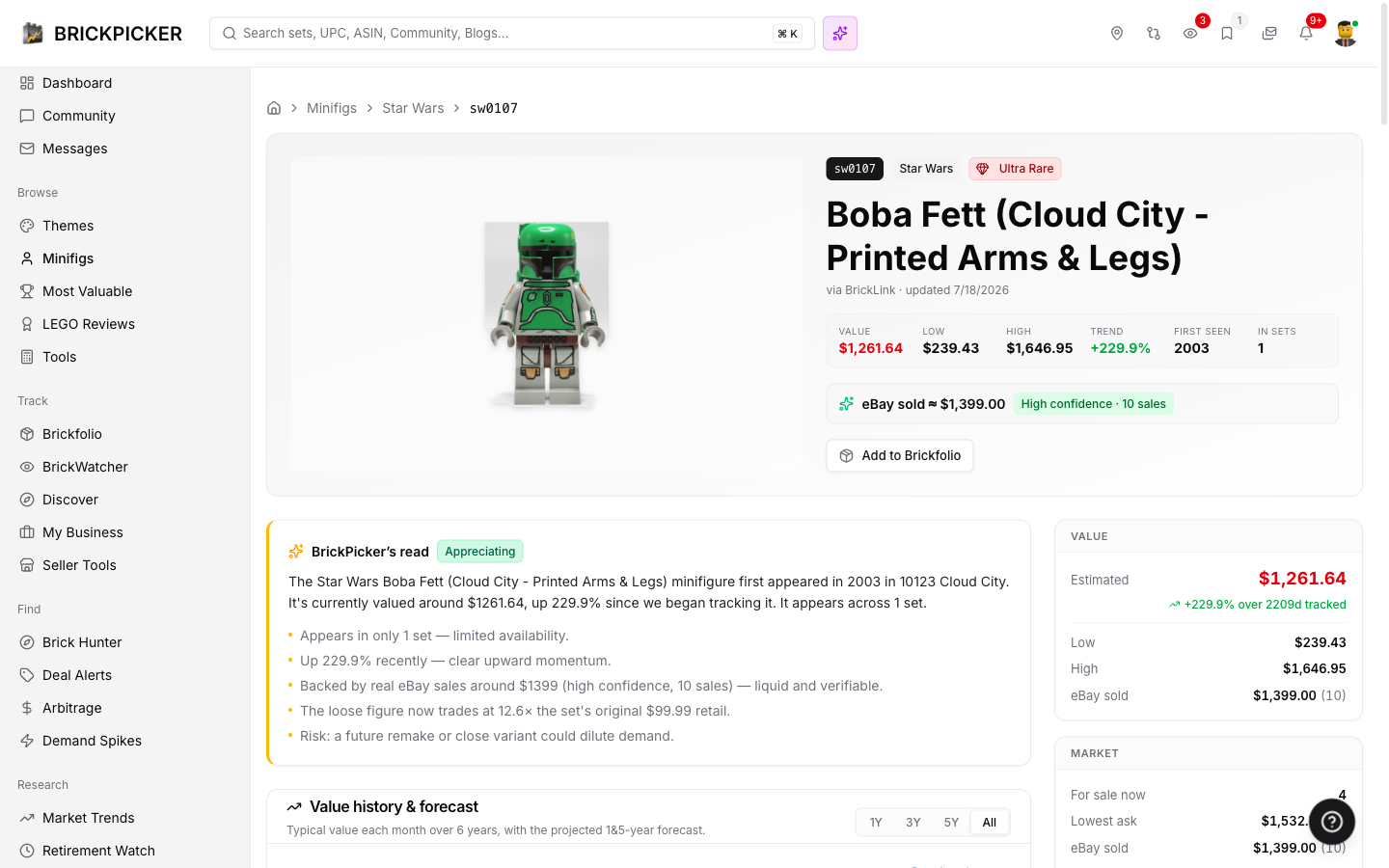
Below the header sits the part we are most proud of, a card we call BrickPicker's read. It is a written, data-driven take on the figure, not a wall of numbers. For Boba Fett it explains, in plain language, that this is a scarce and appreciating figure: exclusive to a single retired set, up a measurable amount since we began tracking it, backed by real sold prices, and now trading at several times the original retail cost of the set it came in. It even flags the risk, that a future remake or close variant could dilute demand. Every scored figure gets this treatment, with a verdict badge that reads at a glance: Scarce and appreciating, Appreciating, Stable, Cooling, or Scarce.
The price history you could never see before
Under the read is a full value history and forecast chart. This is where a minifigure stops being a static price and becomes something you can actually study.
The chart plots a figure's typical monthly value over multiple years, with a low and high band around it, and then projects a dashed forecast cone out to one and five years. You can toggle the range between one year, three years, five years, and all time. For a figure like Boba Fett, you can finally watch the shape of the market: the long quiet stretches, the step-ups after the set retired, the momentum of the last few years. Free members see the most recent year of history. Full history and the forward forecast are part of a BrickPicker subscription.
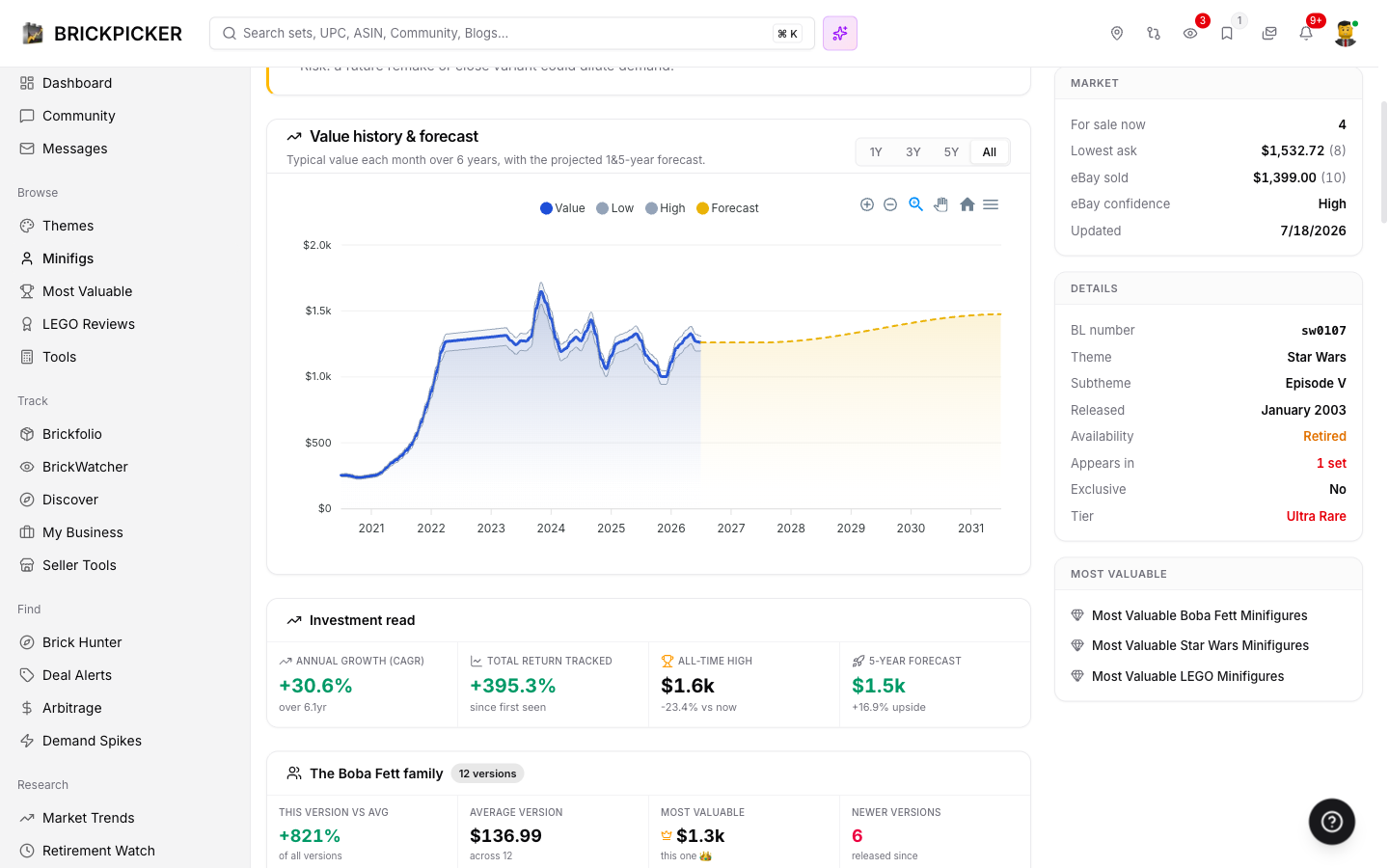
Alongside the chart, subscribers get an investment read panel that turns the history into the numbers investors actually ask for: the annual growth rate, the total return since we started tracking the figure, how far today's price sits below its all-time high, and the projected upside over the next five years. These are the same style of metrics BrickPicker has always published for sets. Now they exist for figures too.
The family view: where a minifigure's value really comes from
Here is the one that took the most work and, we think, matters the most.
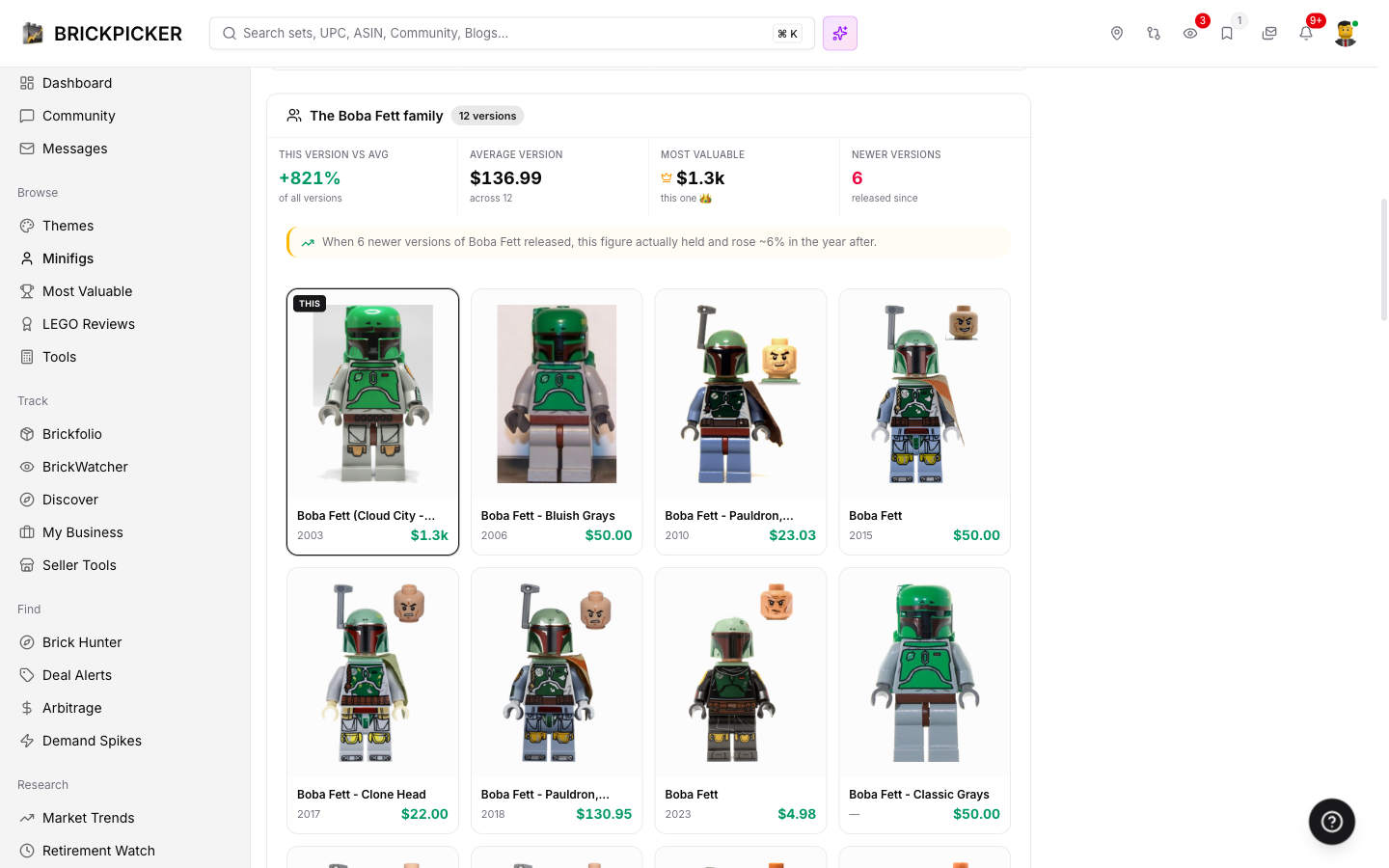
Most minifigures are not unique. There are dozens of Batmen, a long line of Darth Vaders, a whole squad of Stormtroopers across the years. A price on one of them, in isolation, is close to meaningless, because the thing that actually moves a minifigure's value is what happens to its siblings. When LEGO releases a newer, nicer version of a character, the older one can crater, or it can hold and climb because collectors now treat it as the original.
So we built the family view. On any figure with variants, you get a panel showing every version of that character laid out on a timeline, each with its image, year, and value, with the one you are looking at clearly marked and the most valuable one wearing a crown. Above it, an insight strip tells you how this specific version compares to the family average, which version is worth the most, and how many newer versions have been released since.
And then the part that makes it more than a photo gallery: a cannibalization signal. We look at what actually happened to a figure's price after newer versions dropped, and we tell you. Sometimes it reads "when three newer versions of this character released, this figure softened about 18 percent on average." Sometimes it reads the opposite, that the original held and rose in the year after a reissue. Either way, you are no longer guessing whether the new one will kill the old one. You can see the historical pattern. The family view and its cannibalization signal are part of a subscription.
Marketplace, liquidity, and what it is really worth to sell
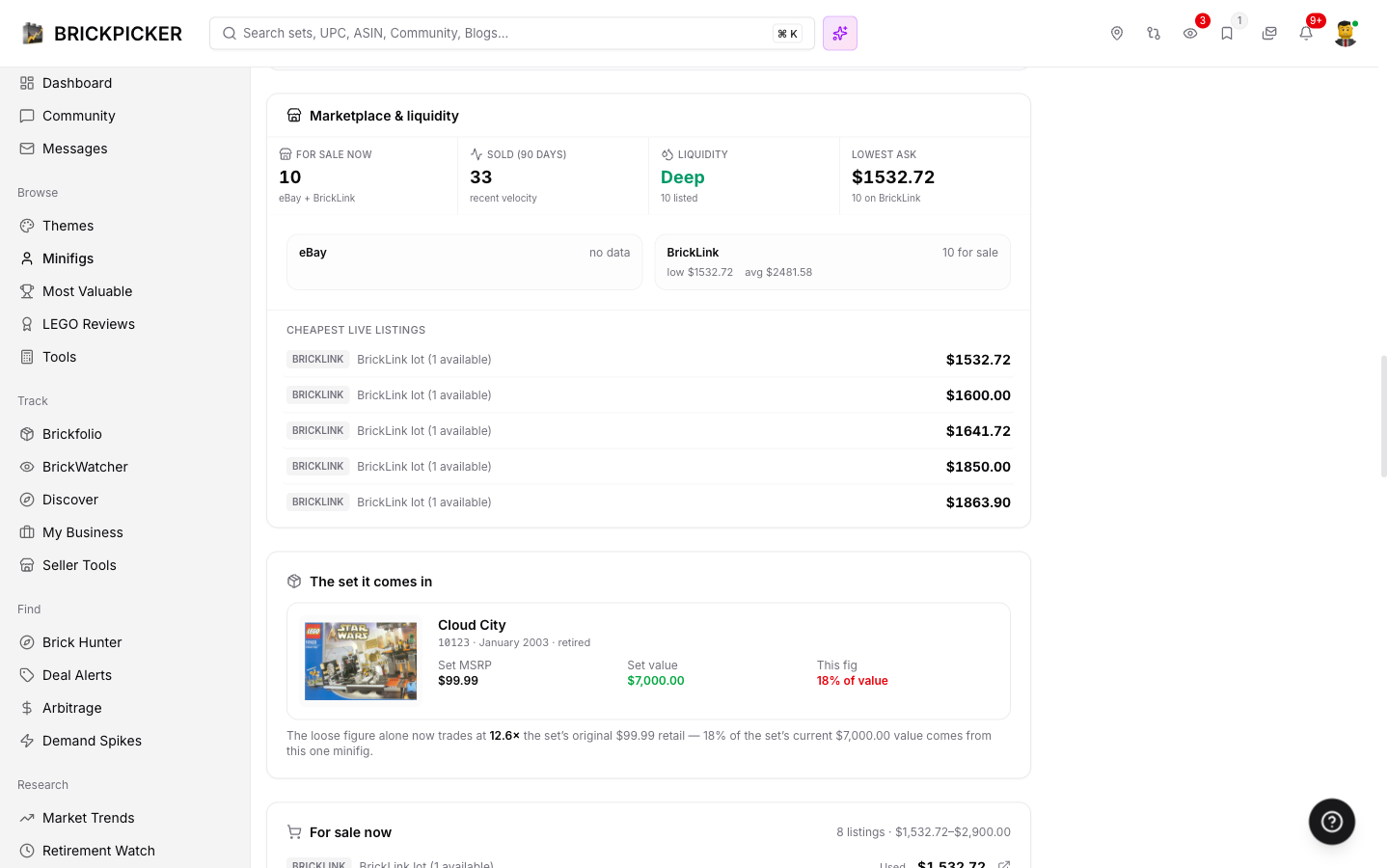
A value is only useful if you can act on it, so every figure page also carries a marketplace and liquidity panel. It shows how many are for sale right now, how many have sold recently, the lowest current ask, and a plain-English liquidity read: Deep, Moderate, or Thin. A figure worth $500 that sells twice a year is a very different proposition from one that sells every week, and now the page says so out loud. We pull live listings and sold data from eBay and BrickLink, break the market down by each, and list the cheapest available copies so you can see the real floor.
Two new maps of the market: the Most Valuable rankings
Sitting on top of all seventeen thousand pages are two new hubs that let you explore the top of the market instead of searching one figure at a time.
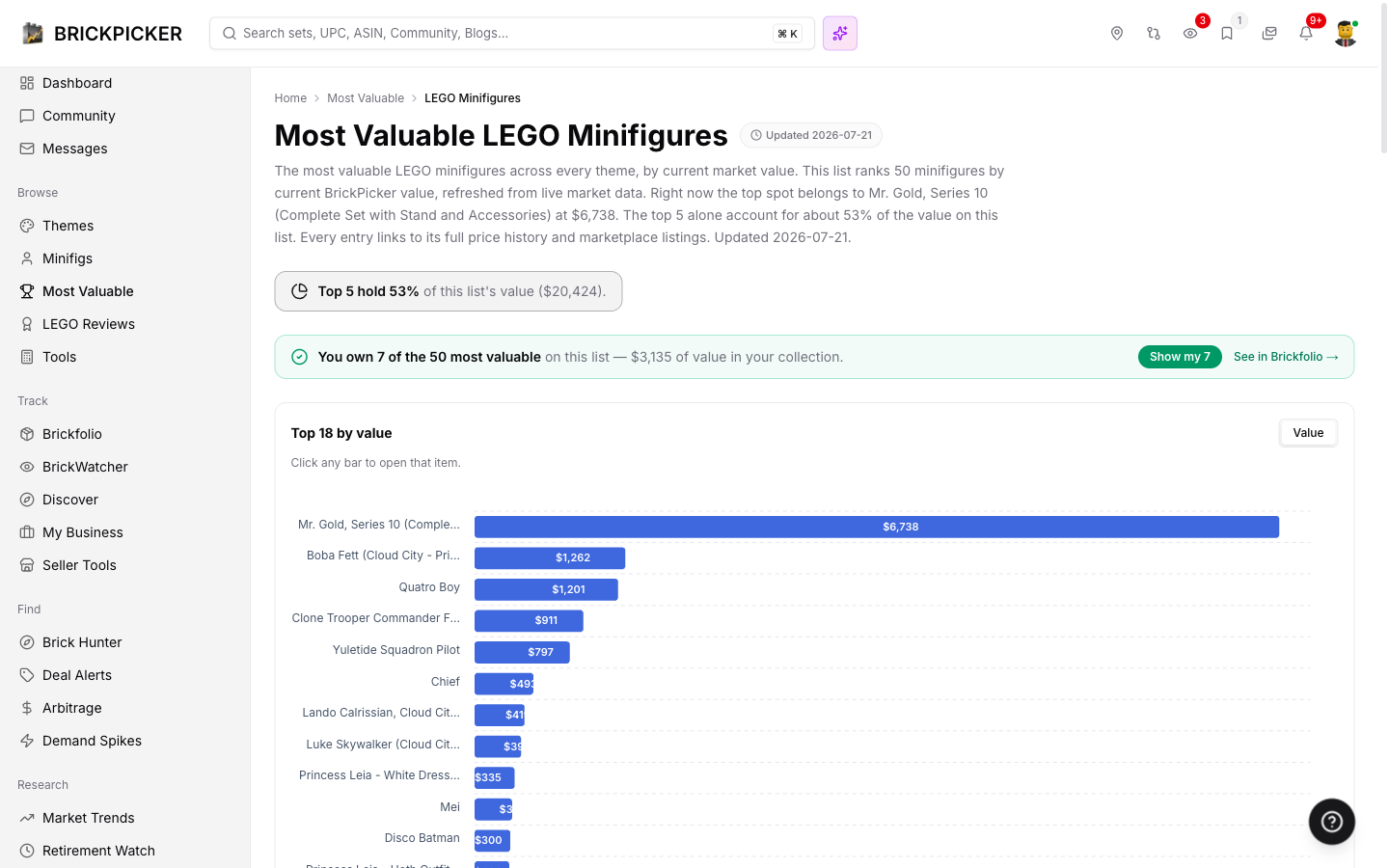
The Most Valuable LEGO Minifigures ranking lists the highest values we track, with an interactive chart you can flip between value and growth, a sortable table, and facets that let you slice the market the way collectors actually think about it. Browse by theme, jump straight to the priciest Star Wars, Batman, or Harry Potter figures, or open a curated character family like Darth Vader or Yoda. There is a list for the figures on the move, the biggest recent gainers, and a dedicated view of sealed collectible minifigure boxes. It sits right next to the matching Most Valuable LEGO Sets ranking, so for the first time the whole market, figures and sets, is one connected map you can walk through.
Every list opens with a real, current headline. The minifigure ranking will tell you that the top spot belongs to Mr. Gold at around $6,738, and that a small handful of figures at the top account for a large share of the entire list's value. These are not decorative numbers. They are pulled live from the same data that prices your collection.
And if you are logged in, the list knows what you own
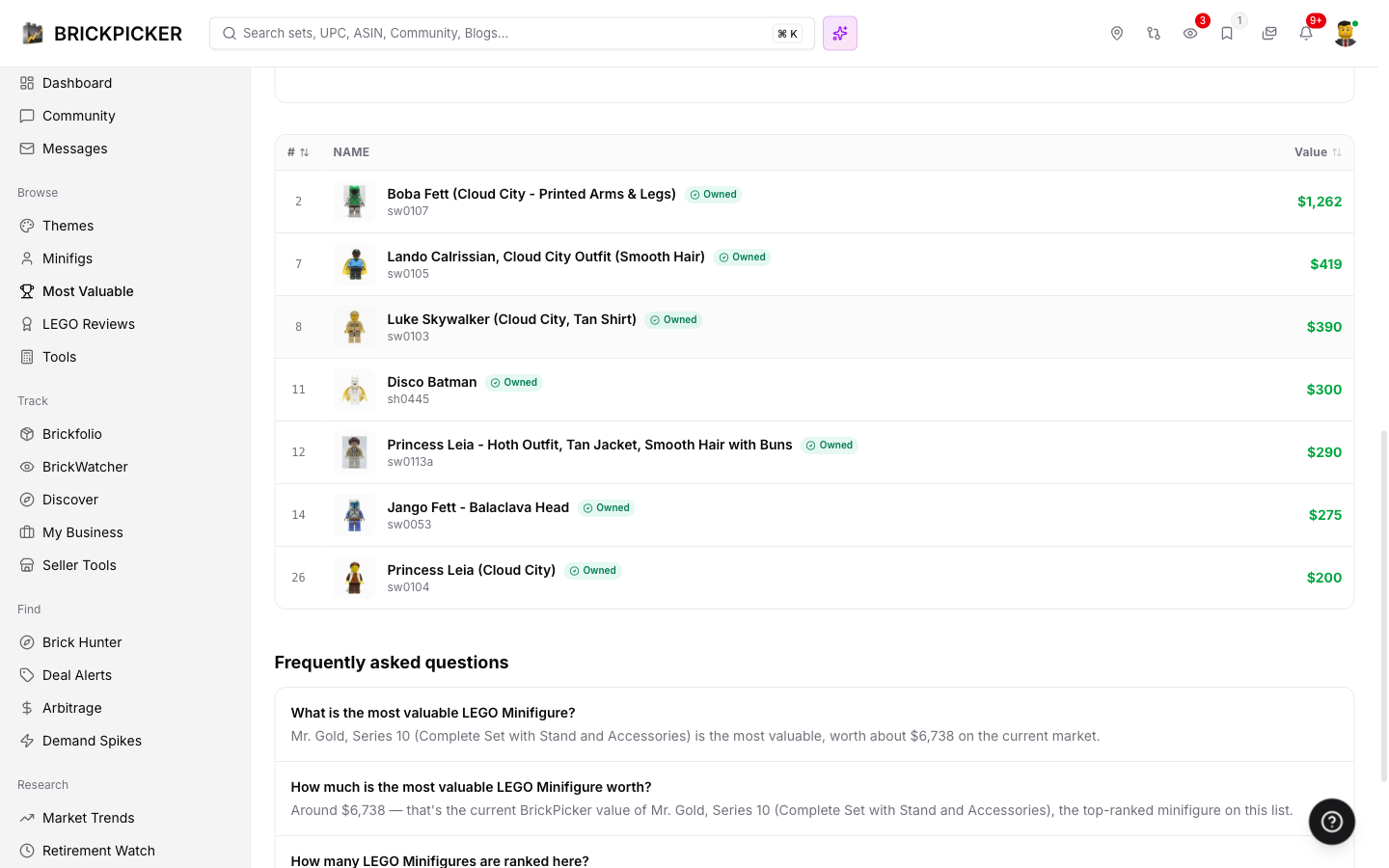
This is the part collectors tend to like most. When you are signed in with a Brickfolio, every Most Valuable list shows how many of them you already own. A green banner at the top might tell you that you own 7 of the 30 most valuable figures in a theme, with a running total of what those holdings are worth. A single toggle filters the list down to just your figures, each owned row wears an "Owned" badge, and one click takes you straight to exactly those items inside your real Brickfolio, with all their tracking intact. It turns a list you read into a list about you.
Built on real sold prices
Every value in the guide is grounded in real market data, and we are deliberate about where it comes from. The headline value reflects the broad market for a figure. Where a figure trades often enough to have a trustworthy sold record, we anchor to actual eBay sold prices and show you how many sales that is built on, so the number is verifiable rather than optimistic.
That grounding is the whole point. Jango Fett with the balaclava head is priced at about $275, and that figure sits on 56 real completed eBay sales. Disco Batman at roughly $300 is backed by 21 sales. Luke Skywalker in the Cloud City tan shirt at about $390 rests on ten. When a figure almost never trades, we say so and lean on marketplace listing data instead, because a value nobody can act on is not really a value. We rebuilt how figures are priced specifically so the numbers track what items truly sell for on eBay and BrickLink, not what a hopeful seller stuck on a listing. If you noticed some minifigure values shift recently, that is why, and they are more honest for it.
Woven into the whole platform
A price guide that lives on an island is a lookup tool. What makes this a launch rather than a page is that the minifigure now flows through the entire platform. Wherever BrickPicker already helped you make a decision about a set, it now understands figures too.
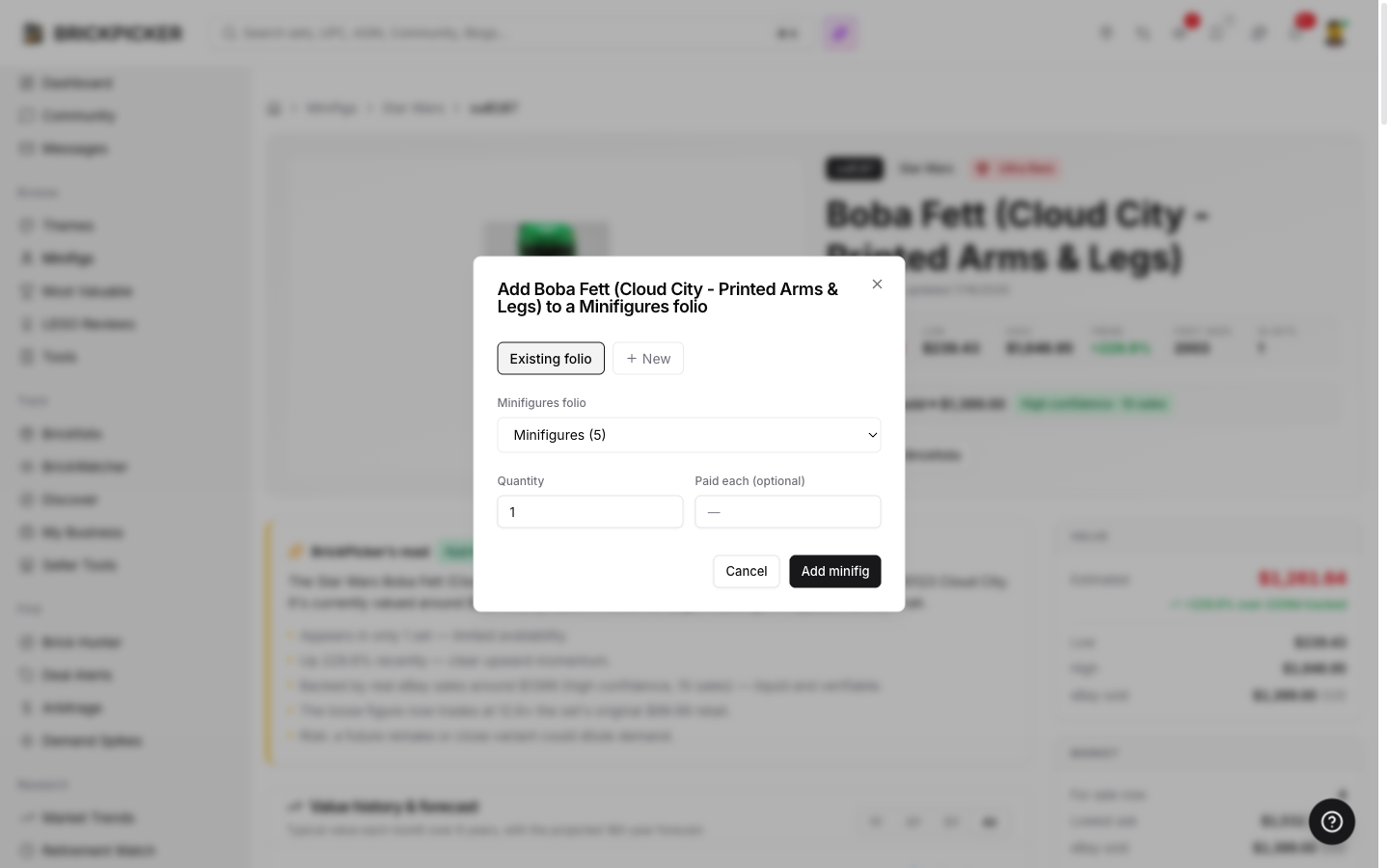
Brickfolio (free). You can add any minifigure, or a sealed collectible minifigure box, to a Brickfolio right alongside your sets. Set a quantity and what you paid, and the figure tracks its value, gain, and history exactly like a set does. Figures live in their own Minifigures folio, so your collection stays organized. Free accounts get one Brickfolio; keeping a separate figures folio alongside your sets is a subscriber feature, and the app tells you so when you reach the limit.
Sales Ledger (Reseller). When you sell a figure, you can log it in the ledger the same way you log a set. Record the sale against the figure's BrickLink number and it flows into your profit and loss with the correct value and fees, and it rolls up under a clean "Minifigures" line in your analytics and theme breakdowns. Your books finally reflect the figures you flip, not just the boxes.
Insurance and appraisal documents (paid). Your minifigures now appear on your insurance and appraisal certificates as their own line items, each with its identity and market value. Because a certificate is a snapshot in time, we freeze each figure's name onto the document at the moment you issue it, so an appraisal you generated last year still reads correctly next year. Your paperwork now represents your whole collection, not only the large sets.
Max Profit (paid). Our natural-language buying assistant now speaks minifigure. You can ask it things like "most valuable Star Wars minifigures," "cheapest DC minifigures," or "retired Batman minifigures that appreciated at least 20 percent," and it understands you are asking about figures, not sets. It knows the difference between a figure search and a search for sets that happen to contain valuable figures, so the tools see the full value in a lot instead of stopping at the box.
Sets and minifigures, finally connected
A set is more than a box, and now BrickPicker treats it that way from both directions.
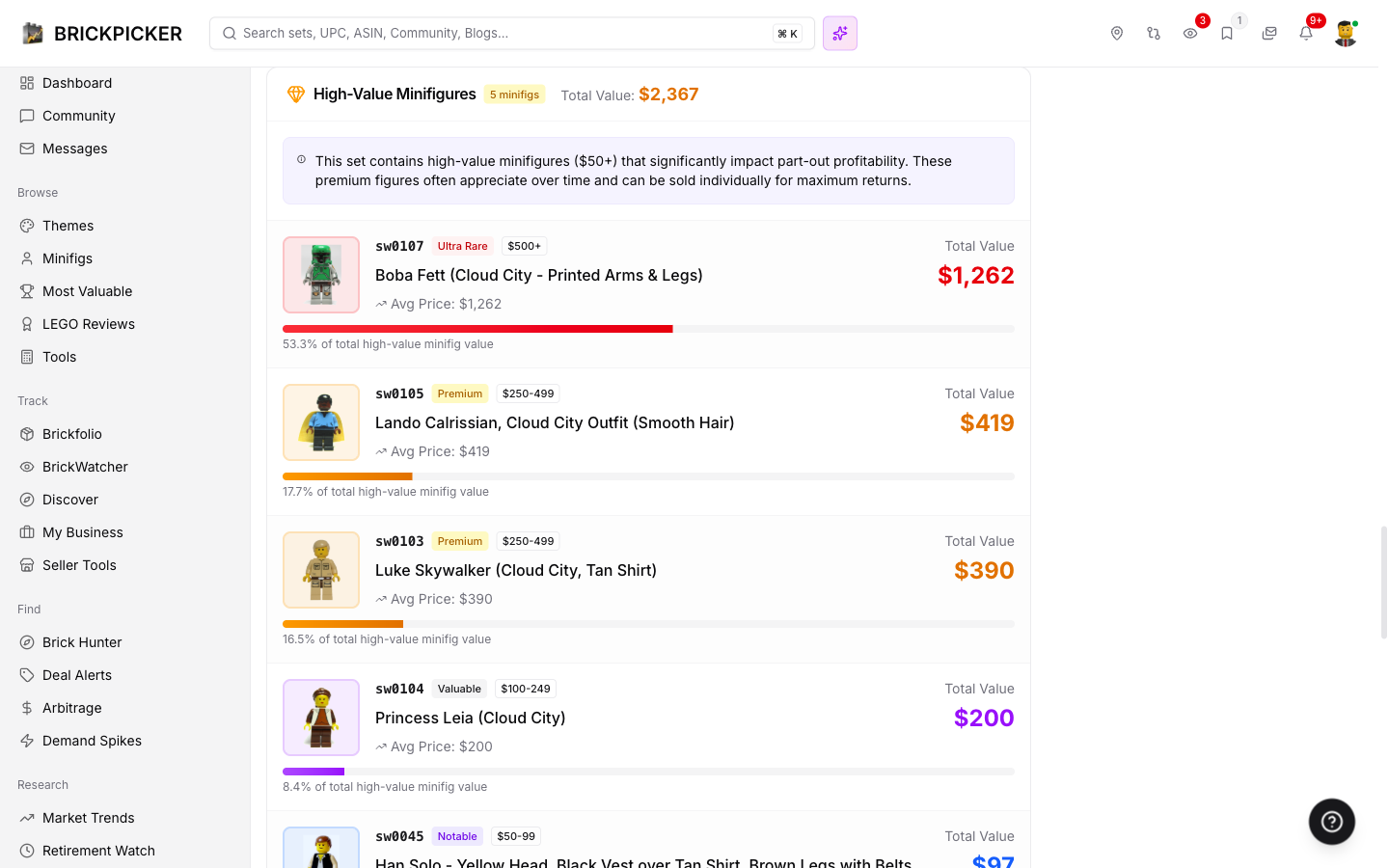
Open a set page and you will find a High-Value Minifigures card that surfaces the premium figures inside, each with its tier and value, and a running total of what those figures contribute. It spells out the thing every reseller already suspects: that a large share of a set's worth can be walking around on two plastic legs. On a figure like Boba Fett, the set page and the figure page agree that the loose minifigure alone now trades at several times the set's original retail, and that a striking percentage of the set's entire current value comes from that one figure.
From the figure's side, the connection runs back the other way. Every minifigure page shows the set it came in, the other sets it appears in, and the figures that shipped alongside it, all linked, all with their own values and BrickScore review pills where we have them. You can follow a grail figure to its set, or follow a set to the quiet figure that is carrying its value. The two halves of the LEGO market are now one graph you can actually explore.
What is free, and what is not
We want the minifigure price guide to be the default answer to "what is this figure worth," so the core of it is free for everyone. Every figure's current value, its image, the sets it appears in, the most recent year of price history, and the number of variants in its family are all free, along with the full Most Valuable rankings and the ownership overlay on your own collection.
A BrickPicker subscription unlocks the depth: the full multi-year price history and forward forecast, the investment metrics, the complete family view with its cannibalization signal, and the full marketplace and liquidity picture. If you are here to look up a value, you will never hit a wall. If you are here to invest, that is the sharpest set of minifigure tools we have ever shipped.
Start exploring
The minifigure has always been the heart of LEGO. Now it is tracked like it.
Browse the Most Valuable LEGO Minifigures and the Most Valuable LEGO Sets, search for the figures you own, and add your grails to a free Brickfolio to see where you stand. Then tell us which figures we should feature next.


